A Letter from Tuscany
Only a painted thing
After DH Lawrence, ‘A Letter from Germany’
Porto Ercole, autumn
I have been to Tuscany before. I thought I knew it. One always thinks one knows Tuscany. Everybody knows Tuscany. It is on the biscuit tins.
I have photographed the regiments of cypress trees lining the tracks and roads.
I have been to Volterra and sought out the old married couple who are still glaring at one another after two thousand years. I have been to Florence, too. We will not speak of Florence.
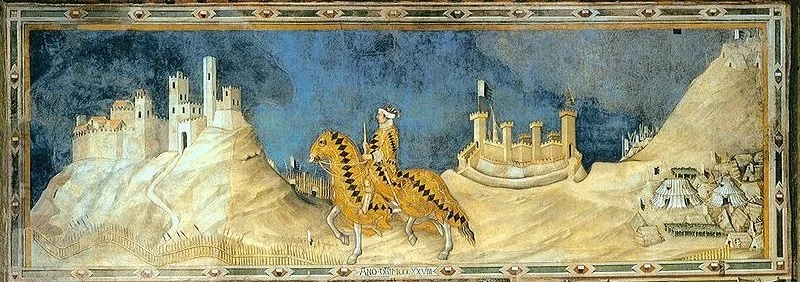
And here I am again in Siena, in the Sala del Mappamondo of the Palazzo Pubblico, where a man rides alone across the wall. Guidoriccio da Fogliano, a hired soldier, all in gold and black diamonds, on a horse dressed to match. No battle. No army. Nobody on the road. Only bare ochre hills, the castle he has come to take, and an ultramarine sky going black above him. And he looks so pleased with himself! I love the simplicity of it: the unadorned landscape, the solitary rider. I have stood in front of him many times.
Twenty American art students sit on the benches and lean on one another and scroll on their phones, while their teacher points at the mercenary. Two of them look. Two out of twenty. And I do not blame the eighteen. Why should they look? The picture has become the place, and the place has become a picture, and there is nothing to look at that they have not seen already, on a screen, a thousand times.
*****
This time I have come on my bicycle, over the hills from Pisa, to ride into the painting rather than just look at it – on through his hills and out to the sea. And I have realised at last what has always troubled me. It is not that something has happened. It is that nothing has.
The hills are the same hills, the cypresses stand in their rows like soldiers on a processional route, the towns sit on their knolls as they always sat, the bells ring for early service.
Nothing has changed.
It is not natural for nothing to change. A living place changes. Only a dead thing, or a painted thing, stays exactly as it was.
*****
At Pisa they hold up the Tower. All day long, hundreds of them, thousands, from every corner of the earth, stand in rows on the green grass of the Field of Miracles with one arm raised, pushing at the air, so that in the photograph they will be holding up the Tower and saving it from falling. All day long. Men, women, children, grandmothers. One arm raised, the face composed into a smile, the phone held out by a friend. And the Tower goes on leaning, quite indifferent, as it has leaned for eight hundred years.
It is a gesture. A whole world making the same gesture, at the same building, for the same picture. Not one of them looks at the Tower, or at the Baptistery beside it. Rather, they look at the phone, to see if they have got it. The photo of them and the Tower. And then they go away from the Campo to eat an ice cream.
And I – I did it too. Bits of tower, bits of a face, half a bike.
*****
Go out into the country, then. Get away from the Field of Miracles and the ice cream, out on the old roads, into the hills.
The hills are beautiful. Of course they are beautiful. Rolling, grey-brown, ivory-white roads winding over them between the dark cypresses, great fields of ploughed earth the colour of a cappuccino, crusted and cracked, the poderi, the square, austere farmhouses, on every knoll, each one walled in and keeping itself to itself. Each could be Montemassi. No pylons. No traffic. No structures of steel and glass. Nothing of now.
It is Martini’s landscape, exactly as he painted it behind Guidoriccio seven hundred years ago.
Exactly. Even the emptiness.
There is nobody on Martini’s road, nobody in his fields. Guidoriccio has seen to that: this is a land that has been conquered. Here, too, there is nobody. But nobody has conquered it. The people have simply gone.
The land is worked. It is still a working landscape. The fields have been ploughed and harrowed, the vines pruned, the olives will be picked. But the work is done by machines and by men one never sees. The farmhouses that the peasant families lived in, one family to a farm, grandmother to baby, are empty of them now. Look them up on Booking.com. A pool where the threshing floor was. Linen sheets. Unadulterated luxury, priced accordingly.
So the land works, but nobody lives in the work. The body goes on; the heart has gone out of it.
And one goes over it on a bicycle, grinding up the gravel slopes, and the silence is post-apocalyptic, and one feels oneself a trespasser. It is as if I had ridden into Martini’s painting and could not find my way back. My own age, my own century, the twenty-first, has no business here. It is not wanted. It may look, and pay, and go away.
*****
They have even made new ruins.
On a ridge above Lajatico, on a road called – of course it is called – the Strada del Silenzio, there is a theatre: a dip of hillside facing an arc of travertine blocks cut to look like the ruins of an ancient sanctuary. They are not ancient. They were cut this century. And above them a huge cracked stone head, new-made and made to look broken, gazes out across the empty land.
New ruins. A people who make new ruins have given up on the future. They have decided that their business is the past, and that the past is what sells.
And the cypresses! The famous cypresses, the zigzag road up the hill in the Val d’Orcia, on every postcard, every calendar, every box of cantucci in every airport in Europe – planted less than a hundred years ago, by an Anglo-American heiress, Iris Origo, so that she would have something lovely to look at from her terrace.
I honour her. She found that valley ‘lunar, pale and inhuman’, and she filled it with people – farms, families, a school, a clinic – and gave them work and dignity. And the families have gone. And what remains is her view: sentinel cypresses lining a rough track to a farmhouse, and the whole world come to look at it. The view has outlived the life it was meant to look upon.
*****
At Pienza one can hardly see the town for the people.
A pope built it – Pius II – as an ideal Renaissance city, everything to be seen from the one square. Perfect in every way. And so it is seen. In every doorway, on the steps of the cathedral, a Chinese bridal couple: she in white, he in his dark suit, and the photographer directing them, a little to the left, chin up, again, and the assistants holding the reflectors, and the next couple waiting. One jostles through them with a bicycle. One says scusi, scusi. They do not see you. They are looking at the lens.
It is easy to mock them. But they are doing nothing that Guidoriccio did not do first. He too had himself pictured in his finest clothes, in front of the place he had come to conquer, looking very pleased with himself. The only difference is that his portrait took rather longer than a click.
And all round them the shops spill out into the street: cheeses, leather, linen, bottles of Brunello. Buying and selling. There is nothing wrong. Everybody is happy.
Why, then, does it feel so dead?
Because it is all being seen, and nothing is being lived. The bride and groom are not getting married on those steps; they were married long ago, at home. They have come here to be photographed being married. The shop is not selling cheese to a housewife who will eat it; it is selling Tuscany to a tourist who will take it home in a bag. The square is not a square, it is a backdrop. The whole of Tuscany is turning into a backdrop. One stands before it and has one’s picture taken.
******
The Maremma.
South of Amiata the land turns dry and red, and the woods thin out, and the white roads give way to stony, broken tracks that shake the bike to pieces. Ruined farmhouses, untended fields, red dusty tracks miles from any town, leading off to I know not where.
Lawrence came here a century ago, looking for his Etruscans, and they told him: ‘Nothing! Nothing! There is nothing there!’ They meant there were no ruins worth his trouble. They were wrong. The Maremma was never empty. It was full of bandits.
Domenico Tiburzi, il Re della Macchia, the King of the Scrub! Twenty-four years he roamed these hills – fed by the shepherds, paid by the landowners to keep the peace, hunted across the scrub by the carabinieri – until, in 1896, they cornered him in a farmhouse near Capalbio and shot him dead.
*****
I had a fever as I rode through the Maremma, and it fevered my imagination as well as my body. Behind every ruined wall, a rifle barrel. Any moment now, Tiburzi would step out, and his band behind him, rough, unshaven men in battered hats, bandoliers across their chests, guns pointing at me, demanding more than my phone. Perhaps my bike.
Nobody stepped out.
But nobody had painted them out, either. Nobody has made a picture of the Maremma. It does not appear on any biscuit tin. It is rough, unseen and alive: a wild land, more in keeping with the less-kempt South than with the bankers’ land up the road.
And at Ansedonia, in a seaside resort full of September-shuttered villas, an old man in stained trousers shuffled out of a decaying restaurant and told us he was open, and set the table one fork at a time, and brought us bad pasta with a face black with misery, and could not find the card machine. He was the only man in Tuscany who was not performing Tuscany. He was simply a cross old man in a failing restaurant. I loved him for it. He was real.
*****
So I come down to the sea at Porto Ercole, and sit by the harbour, and the forts stand over the bay. Like Guidoriccio, I have reached the coast unrobbed, and rather pleased with myself.
This is where his story ends. In 1328 Siena sent him to take the Maremma, and painted him on the wall. In 1555, here, the last of the Sienese held out against the Medici – and lost – and the old Republic was finished. And because Siena lost, its lands are still so beautiful. Nobody had the money to change them. Nobody had the reason. Preserved by defeat, as Pompeii was preserved by ash.
Tuscany has become its own museum. It is not going anywhere. It has arrived. And a place that has arrived is a place the present can only visit.
Tomorrow I take the train back to Pisa, past the Tower and the people holding it up. I have done what everyone does. I have looked, and paid, and now I go away. And I feel a kind of sadness. Not for Tuscany. Tuscany will be all right. It will go on being beautiful for ever, like a face on a coin.
The sadness is for the rest of us, who keep coming to look.
Where are the Futurists when you need them?
(First published on Substack November 2026)