Bomber Country
Bomber Country
Bomber Country
By the fourth day of my ride from London’s old fish market to Grimsby, my body had settled into the steady rhythm of touring — ride, eat, sleep, repeat. Leaving behind London’s relentless noise, I’d ridden through Hertfordshire’s idealised garden cities, and crossed the Fens, where the vast sky became the landscape itself.
In Peterborough, I’d been prevented by a security guard from entering the cathedral because ‘children were inside’. Yet March had brought the daffodil fields of Spalding into their golden bloom, and Boston’s market square was so preserved I wondered if horse-drawn coaches might clatter through at any moment.
Day Four was a ride into Bomber Country. Plans to visit Tattershall Castle were thwarted by its closure, so I turned instead to Lincolnshire’s grand Perpendicular church. Towering and flooded with light, it felt more cathedral than parish church. Built by Ralph Cromwell, a Chancellor infamous enough to have dipped into the treasury, the church was only completed after his death by the Bishop of Winchester.
I sat as you do in ancient churches, doing nothing other than watchin dust motes dance in shafts of sunlight. The stone-filled silence was only occasionally interrupted by the faint wind and a robin singing in the trees. Then, abruptly, a low rumble deepened into a deafening roar that seemed to shake the very stones of the nave. The bones of ‘Little Tom,’ the church’s 18-inch-high centenarian resident, shook beneath the chancel.
Outside, jets — Typhoons — roared from a runway mere metres away. Thrilled by this visceral roar, despite my aversion to noise, I raced outside to witness their furnace-white afterburners blaze cones of fire, launching them vertically like rockets into the blue sky. Three jets scrambled. Within seconds they were barely visible in the firmament of blue above before the birds resumed their singing as if there had been no interruption.
Stopping at the nearby 13th century Bluebell Inn for lunch, the publican told me that there are perhaps a dozen scrambles a month. He said it the way you might mention the bus service. He explained that when the Russians approach our airspace over the North Sea, the jets set off to chase them away.
‘This is Bomber Country’, he said. ‘Look up there at the beams’. Squiggled signatures in various coloured pens decorated the tabacoo-brown plaster between the old wood beams. ‘Jimmy 55 SQN’ ‘David ‘Scottie’ 55’, ‘Goblin’. In a beam set into the wall are the edges of old pennies protruding from the cracks in the wood. ‘Paying up front for the pint they never came back for’, added the publican. He said that this whole area was covered in old airfields. ‘As I said to you, this is Bomber Country’.
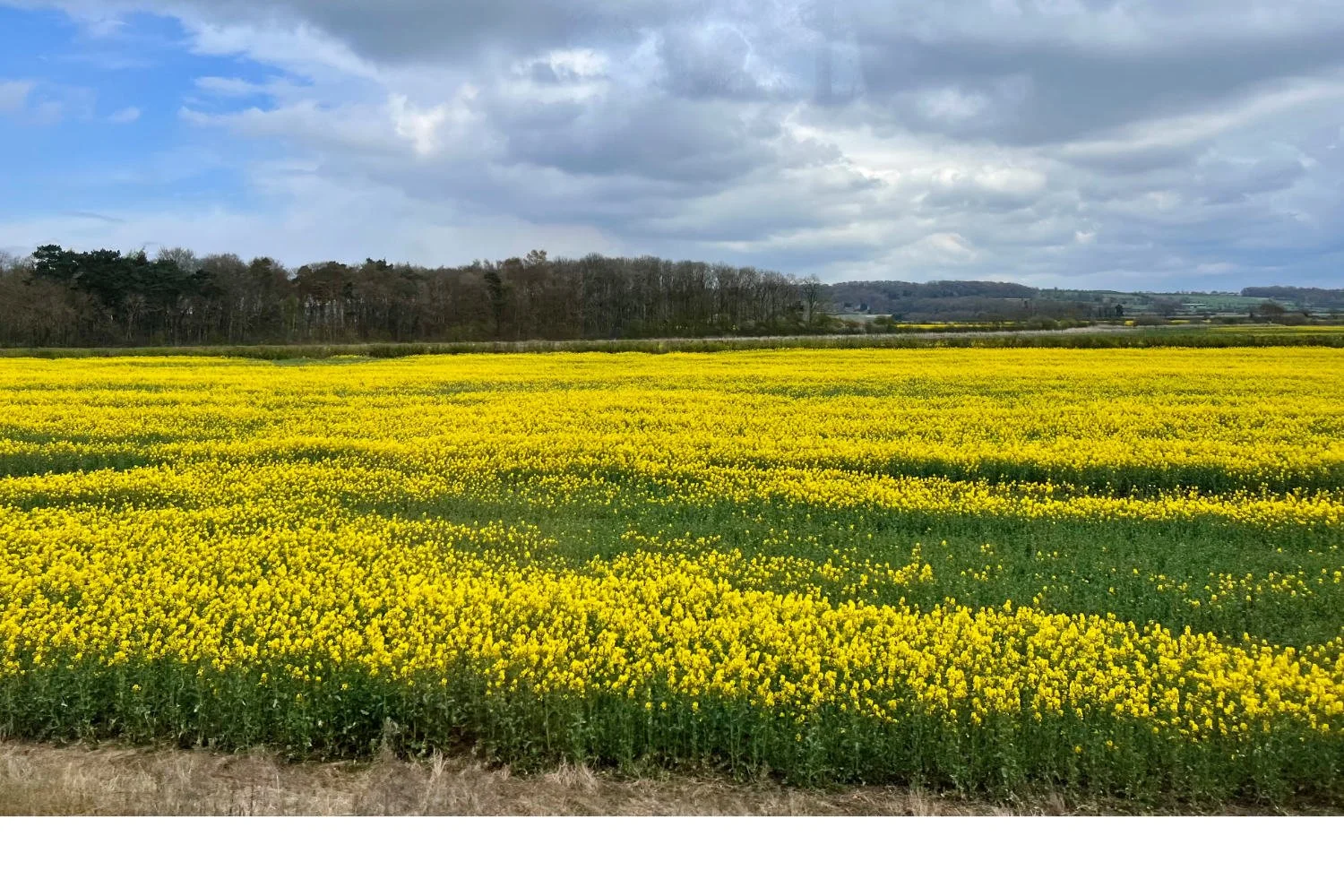
There were an astonishing 49 operational airfields during WWII. With over thirty Lancaster squadrons operating in the area, the county was the primary launchpad for strategic bombing operations into occupied Europe. After lunch, riding towards Woodhall Spa, I passed the vast fields of rape which had once been airfields. Hedge sparrows gossiped in the leafless hedgerows, and pigeons picked the fields. The sky was blue, spring was here and England appeared as it so often does, green, sometimes yellow and always pleasant; old pubs and good beer, churches, castles and narrow country lanes. But there was a price to be paid for keeping it so, as the roar of those scrambled jets made clear. England’s timeless charm required never ending vigilance.
Dedicated to the
memory of the 593 brave Airmen who
took off from this
airfield in defence of
our nation
never to return
To access the route and accompanying ride notes, click here