Into the Heart of Tuscany (Days 1-2)
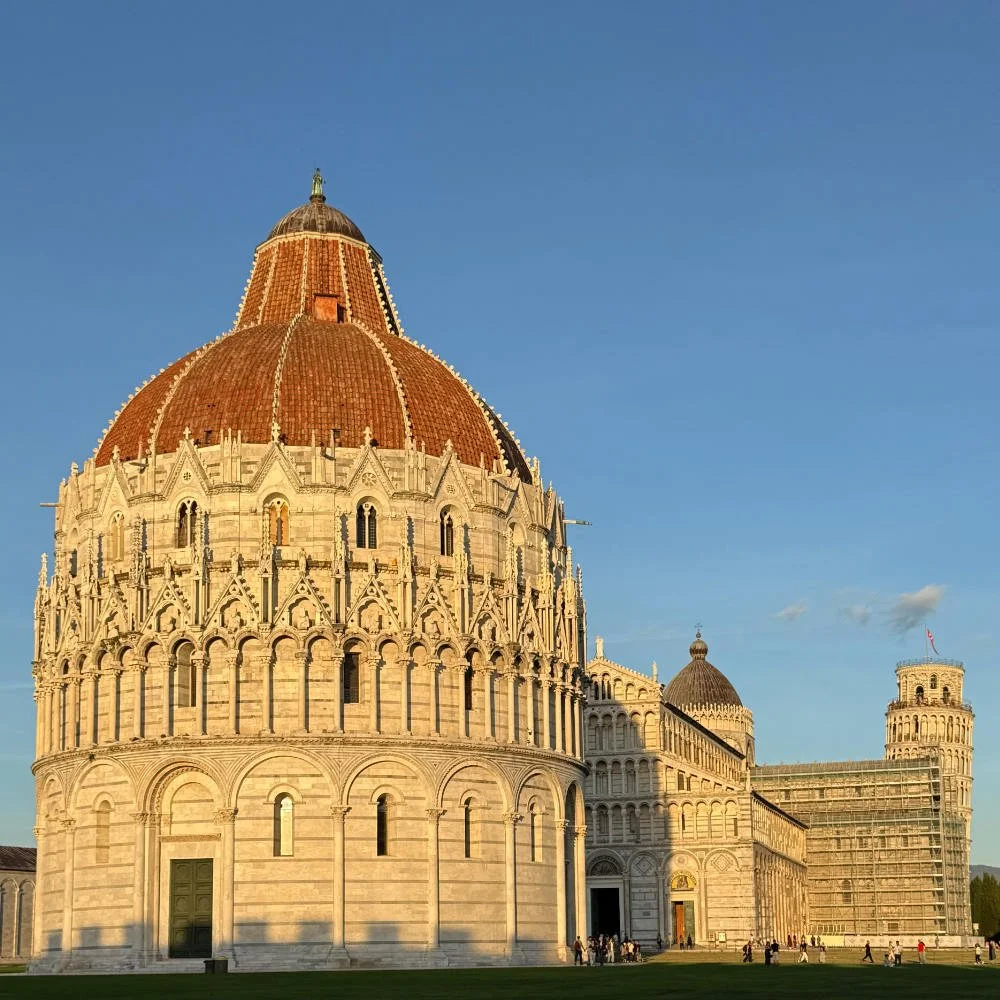
Campo dei Miracoli, Pisa.
Ride Overview
Seven days, some 400km and many thousands of metres of climbing on the gravel roads of Tuscany.
The tourist pictures show silken "champagne gravel" rolling over the hills. This was an altogether different affair, well away from the tourist gaze: thrilling, demanding, eccentric and wonderful. I put together a route that was going to test us as well as inspire us. With friends from my cycling club, we rode 460km rom Pisa to Porto Ercole on the coast, by way of Volterra, Siena, the Val d'Orcia and Saturnia.
The Journal
Days 1 - 2
Pisa, late September
‘There is so much caprice, such an exotic look in the whole scene, that… one might imagine one’s self in fairy land.’
– William Beckford
Dawn peaches the sky as a young man, immaculately dressed in a dark suit, walks fast in his white trainers past the old pensioner shuffling along with his dog. I, the early-morning tourist, thread my way through the maze of streets, grab a cappuccino and brioche, and head to the Campo dei Miracoli, the Field of Miracles. The Tower, the Duomo, the Baptistery and the Camposanto: a theatre in marble. At this hour it is all but empty, and I sit to draw and dream. As the hours tick towards mid-morning, the pavements surrounding the Field thicken with people.
Fairy land indeed. Men, women and children surround the Tower, posing for a photograph, one arm raised to prevent it from falling.
But still the Tower leans.
Why do they all come? Why do any of us? Few, I suspect, could tell you who built it or when. They come for the photograph, a pizza and an ice cream, and they go home happy. It is a question that will ride with me all week, all the way to the sea.
By late morning, with the heat rising, I take refuge in the cool of the Baptistery. I climb to the gallery and wait, my back against the cold marble wall. A cough from another visitor or the shuffle of feet on stone becomes a whole new tone poem. But I am waiting for more than a cough and a shuffle, for I have read Sir Lewis Morris’s ‘The Baptistery’. After some minutes, the old man who checks tickets at the door shuffles towards the font below me.
…The poor guide lifted a worn voice, not sweet
But skilled to evoke the subtle harmonies
Which lurked in those dim heights…
The old man’s voice rises into the dome. The building seems to gather it up and return it transformed.
At two, we meet – John, Ben, Andy and I – beneath the Tower. Before a pedal is turned, we join the crowds, posing beside the Tower and struggling to fit all four of us in a selfie. Bits of tower, bits of faces and half a bike.
So much for my question. We are tourists too.
We ride out over the Arno and into the hills. The sun beats down. My tyre loses air, and Andy’s gears become restless, changing cogs of their own accord. The day is only fifty kilometres long, but it feels like a hundred. At the Villa Conti in Fauglia, gears and tubes are repaired, and we drink beer beside the pool. The sun sets orange; the rolling hills and the chain of distant mountains glow like embers in a grate.
***
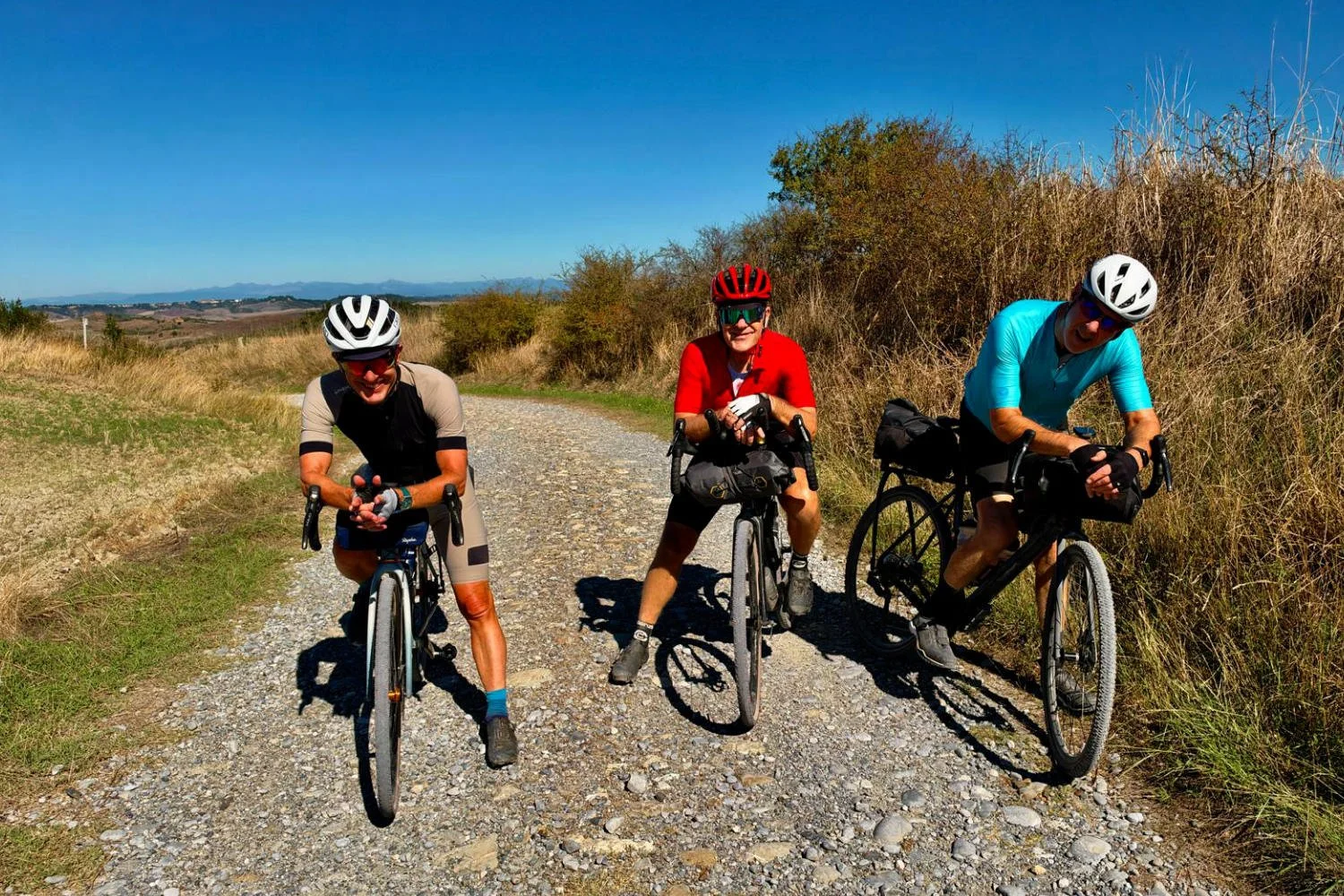
Headache-free the next morning, we assemble at a quarter past nine, like the disciplined cyclists we are, and roll across the Villa’s gravelled forecourt into the cool autumn air.
The road plunges into a tunnel of trees. Our first test of ‘gravel’ is, in truth, an earth floor with a few loose stones scattered across it: a Tuscan holloway, worn by millennia of feet and hooves, and now tyres. For an hour we ride through an Arcadian landscape, light filtering through poplars and olive groves.
But it does not last.
A few quiet kilometres of road. Around a corner and onto a track. A steep, oh-so-steep, we-have-to-walk hill. On either side, the earth has been ploughed into great chunks of rubble-like soil. Fortress-farmhouses, the poderi, sit on knolls, severe, square and red-stoned, walled by softening rings of cypresses.
The rutted earth track becomes a Via Dolorosa in stone. Misshapen blocks, round and square, small and large, have been laid roughly into the earth so that horses once, and tractors now, can find a grip after rain. I never thought I’d bless the cobbles of Flanders. Every part of the bike is shaken; tendons and ligaments tested.
Let me be honest about Tuscan roads, since this is a cycling journal. The cyclists come for the strade bianche, the white roads they have seen on television. Around Siena those roads are superb. Most of the rest are not. They are earth tracks, stone-laid farm roads, broken lanes and busy main roads, and nobody keeps them for anyone. As roads, they are frequently bad. As adventure riding, they are glorious.
The silence is almost post-apocalyptic. Stopping briefly to look at the map, I see that we are riding on a section of road called the Strada del Silenzio. Of course we are. It passes the Teatro del Silenzio, a dip of hillside facing an arc of travertine blocks cut to resemble the ruins of some ancient sanctuary. Ancient they are not: the theatre was made this century, for summer concerts. Along the ridge, Igor Mitoraj’s enormous cracked head gazes across the land, a new sculpture made to look like an old ruin.
Even the ruins here are built for show.
The sun reaches its zenith. No matter how many pedal turns we make, the dark hill of Volterra never seems to come nearer. Each of us has run out of water. At the top, where our track meets the road, there’s a house with an open gate. Ben sees a hose and a tap and rushes to it. We wait behind the hedge and hear groans and cries of disgust.
‘That was disgusting. I don’t think I have ever drunk such foul water in my life.’
Did he run the tap first?
‘No, I was desperate. Yuck.’
We arrive in Volterra exhausted and dehydrated. Either we are suffering the effects of ageing or the ride was particularly hard. We agree that it was the ride.
In the Guarnacci Museum, gallery after gallery holds the small alabaster chests in which the Etruscans of Volterra kept the ashes of their dead. On the lids, flabby, bald men recline on their elbows; the women hold wine cups or fans and are fully clothed and bejewelled. So this is what they looked like, these Etruscans, and how they wished posterity to see them, with their ‘smile, the subtle Etruscan smile still lurking’.
The chest that I seek, for I have been here before, is the Urna degli Sposi, the urn of the married couple, in painted terracotta. They lean on their elbows, facing one another, their dour faces etched with lines, their cheeks a little sunken with age. She has a look of challenging enquiry; he looks away into the middle distance, perhaps conjuring up an excuse or explanation. Why, I wonder, would anyone pay for a likeness showing their unhappiness? Viewer, this was my life: to live with an impossible partner.
Here at last is a portrait not made for show.
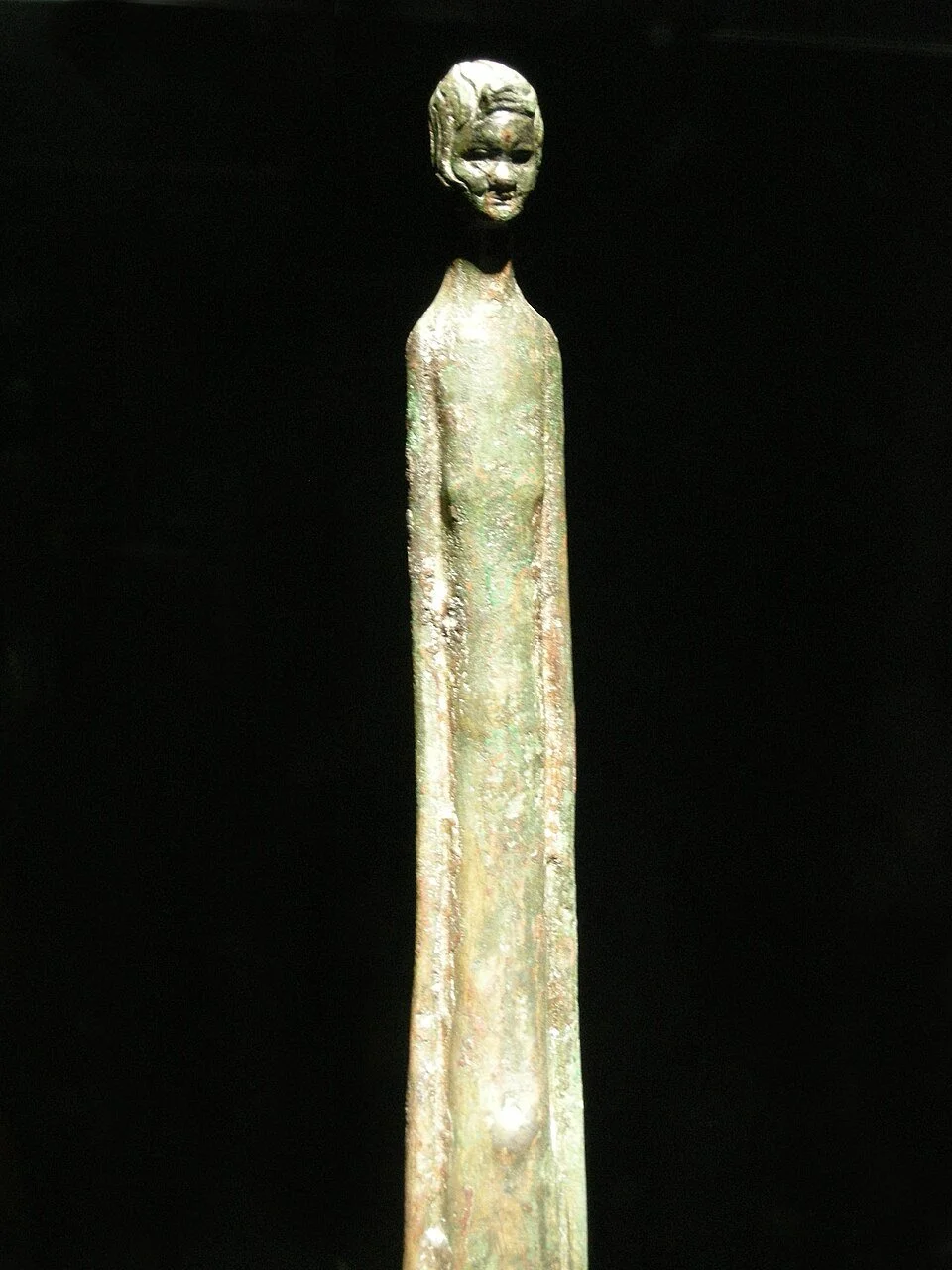
Ombra della sera
I’m lost in drawing the Ombra della Sera, the elongated bronze boy, when the custodian comes clattering round, turning off lights and coughing pointedly.
‘Scusi, signore, siamo chiusi.’