A Tuscan Journey (2)
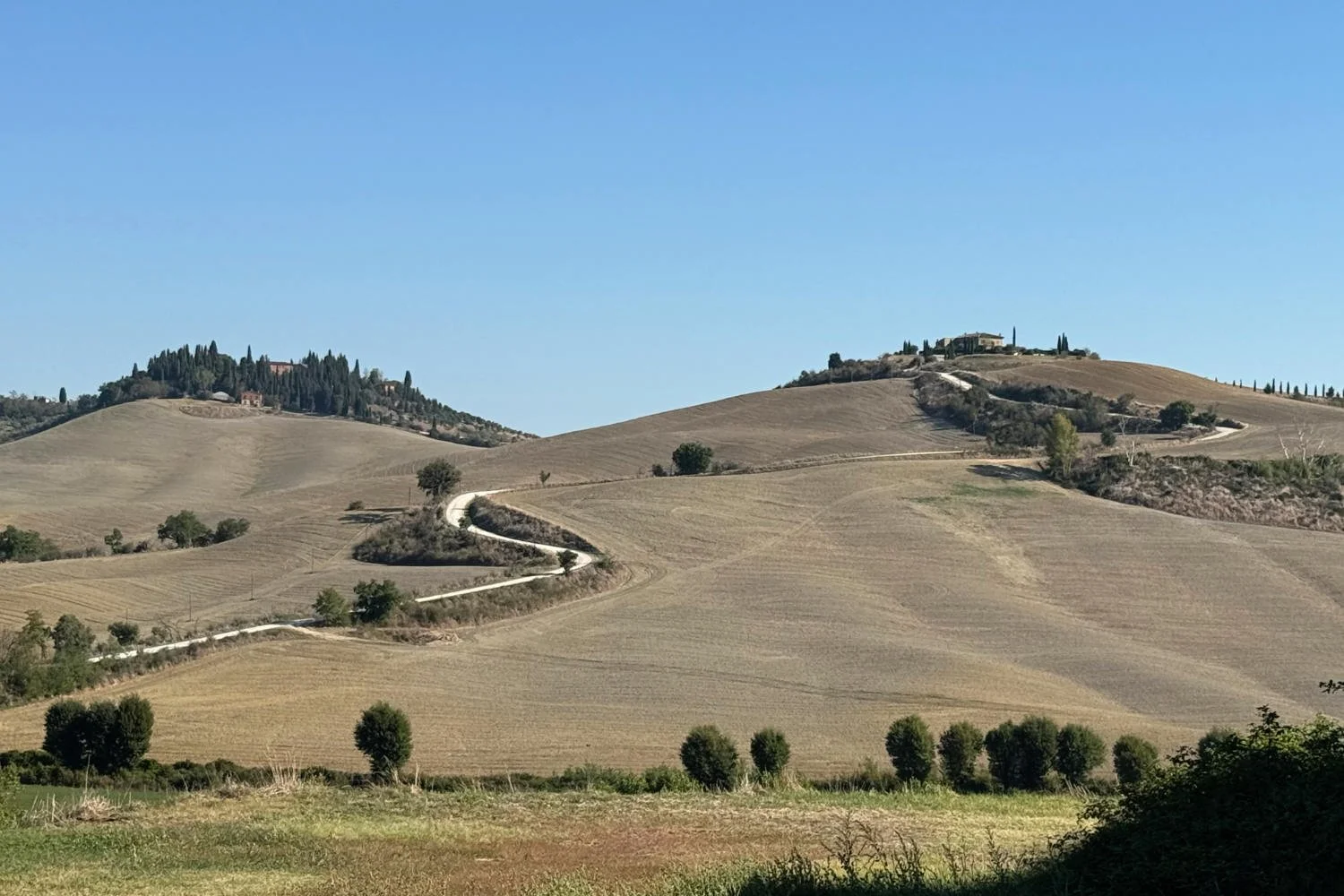
Monte Sante Marie
Days 3 - 4 Volteram Siena, Strade Bianche, Castelnuovo Berardenga
Next morning in Volterra, amber light drapes the upper half of the Palazzo dei Priori, and a tinny bell rings for early service. Students emerge from their homes like bees from a hive, joking and jostling in ever larger groups.
I head to the main square to wait for the rising sun to strike the slender tower. As I line up the photograph, a policewoman drives slowly into the square. She watches me from her car, then looks across to the tower. Just as the sun’s rays stroke the stone, she drives forward with impeccable insouciance and parks directly in my shot. She gets out, gives me a tight smile that says ‘bloody tourists’ and disappears through the enormous doorway of the palazzo.
Setting off from the town, wrapped in windproofs against the early autumn chill, we descend steeply from Volterra’s hill to Prato d’Era. Woods, a twisting road, silence save for tyres on asphalt. A cerulean sky. Leaves falling.
Once we are down on the valley floor, the next ridge rises ahead and all but blocks out the sky. Eleven kilometres of smooth, white gravel twist and turn up through the woods. Windproofs are peeled off. Sweat runs through our eyebrows and into our eyes. We ride in our own worlds, lost in our struggle with the heat, dust and incline. Eventually we reach the ridge road and join the cars, all heading for San Gimignano.
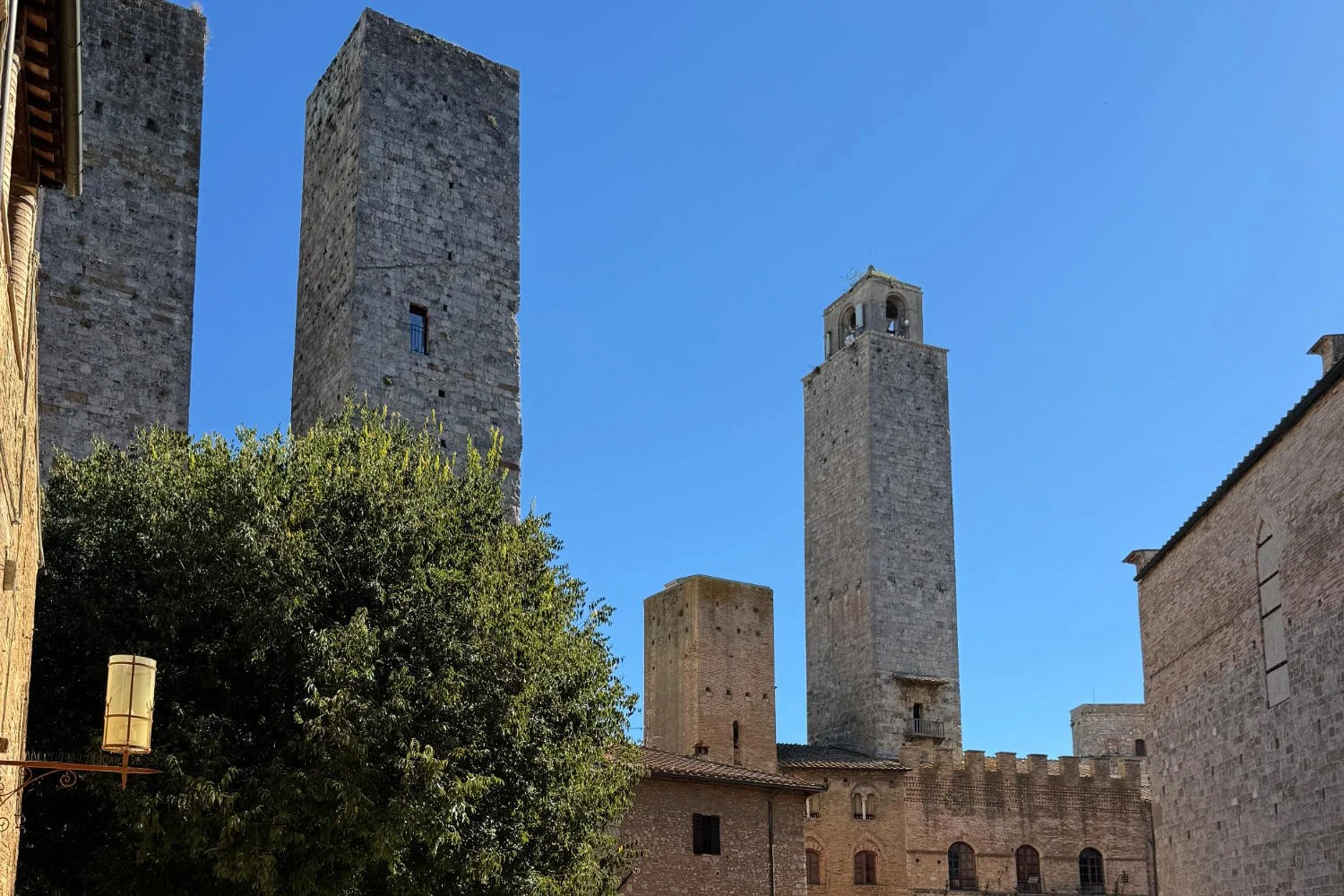
San Giminagno
San Gimignano is a show-off piece: the equivalent of a marina filled not with billionaires’ super-yachts but with stone. As we climb towards the town, I count fourteen towers. There were once seventy-two, each a boast of a family’s wealth and status: the higher the tower, the greater the family’s standing. Medieval plague devastated the population, the Via Francigena was re-routed, and the town became a backwater without the money to rebuild or modernise. What remains is a medieval treasure, little changed: walls, squares and towers.
And crowds.
For this is a ‘Tuscan jewel’ and an essential stop on the modern Grand Tour.
Visitors settle in cafés out of the sun before making their way back down the Via San Matteo to the buses waiting outside the town’s walls.
We weave our bikes through the crowds up the cobbled main street and, like everyone else, search for a table in a café.
Full of expensive cake and coffee, we ride out of town and enter the familiar ideal of Tuscany. The hills are softly contoured, lined with dark cypresses standing like soldiers along a processional route. On the hilltops stand poderi, softer than yesterday’s fortresses. Once worked by peasant families, many are now anything but modest. Look them up on Booking.com, and you’ll find unadulterated luxury, priced accordingly.
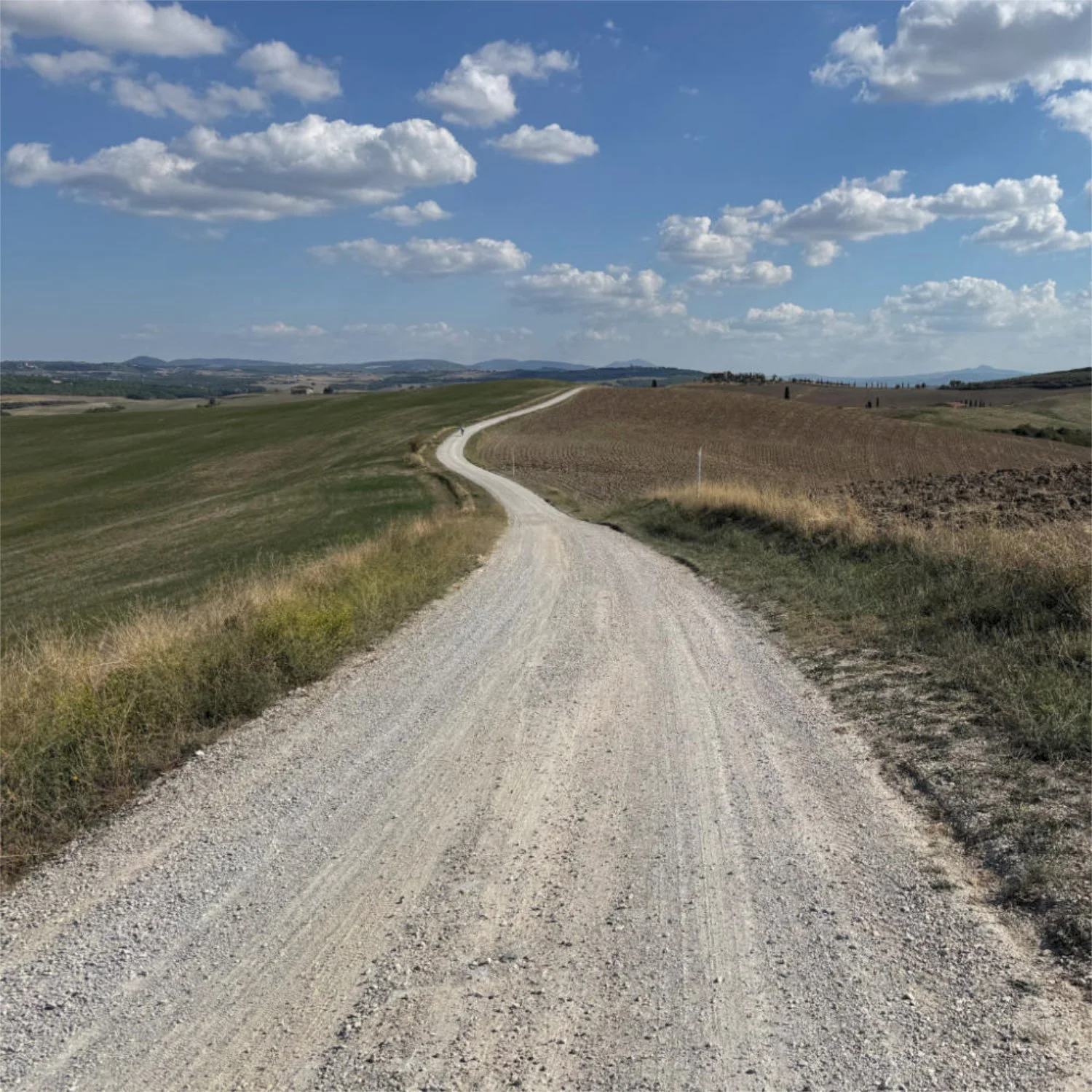
La Strada Biancha
The roads are white with dust, and little plumes dart up from the tyres ahead. We stop for lunch at a trattoria run by a couple who probably should have retired long ago, but who, with a limp and a smile, bring out delectable plates.
With the wine, pasta and gelato settling and our legs remembering their purpose, we pass Monteriggioni, its encircling walls still crowned with towers. Dante likened the giants ringing the pit of Hell to these towers. Today they guard a car park, a café and a few Airbnbs. On the road below, pilgrims tramp towards Rome on the Via Francigena, weary and hot.
Many more kilometres of white roads and hills follow before we ride through Porta Camollia, the pilgrims’ gate. Above the entrance we read: Cor magis tibi Sena pandit, ‘Siena opens her heart to you still wider’.
Once inside the city, we enter a maze of streets, each barely wide enough for a bike. The buildings are tall and close, their colours rusk, ochre and dull pink: burnt Siena. The brick and stone are still warm from the day.
We are trying to reach Via Santa Caterina, made famous as the final climb of the Strade Bianche, where the Pidcocks, Van Aerts and Pogačars of the cycling world make their race-winning accelerations up the sixteen per cent gradient. But in the close medieval streets, our navigation devices lose their satellite signals and beep ‘off route’ as we turn into one narrow street after another.
We lose Andy.
WhatsApp messages ping across the Piazza del Campo, and we follow shared locations down steep, sometimes stepped lanes before meeting up again outside the apartment we’ve booked for the night.
‘Eating is important; eating well is essential,’ said Gianni Brunelli, owner of the Osteria Le Logge. The evening is warm. Pork fed on chestnuts, as delicate as a creamy pudding.
***
After three days of tough riding, four oldish men are tired. Two bikes have suffered from the screw-shaking of the Tuscan roads, and besides, Siena is not a city to leave in a hurry. We decide the morning is for exploring its art and bike shops.
Before breakfast, we wander through deserted streets, framed by arches, down steps and up steps. Church bells. The smell of bread. Gilded sunlight above, cobbles below. Flags hang from poles on the buildings, each representing one of the seventeen contrade, the historic neighbourhoods of Siena, decorated with their own emblems: a goose, a snail, a porcupine, a wave.
On a column at the corner of the street, a small bronze she-wolf suckles two boys. She is all over the city, on columns and above doorways, for the Sienese trace their founding to Senius, son of Remus, and like to think of themselves as cousins of Rome rather than neighbours of Florence. For much of the Middle Ages they were Florence’s great rival, rich on banking, trade and pilgrims passing through. The streets we are walking were built with that money. They survive because, after the siege of 1555, Florence took the business away and the city was largely left alone.
We head for the Duomo, its façade built in bands of black and white marble, which look more severe than reverential. The cleaners are at work inside, and with the great west door open we watch shafts of light beam across the nave.
After breakfast, Andy and I wheel our two wounded bikes to a workshop. He stays to watch the mechanic at work; I head across the Campo to the Palazzo Pubblico.
Inside what was, for several hundred years, the heart of Sienese government, I hurry through room after room to one of my favourite places in all the world: the Sala dei Nove, the room where the Nine, the merchants who governed the republic, met beneath Lorenzetti’s frescoes.
On the walls, Ambrogio Lorenzetti shows the consequences of good and bad government: on one, a busy, well-ordered city and its cultivated countryside; on the other, a ruined town, soldiers roaming and neglected fields. A reproduction ought to hang in every government office in the world.
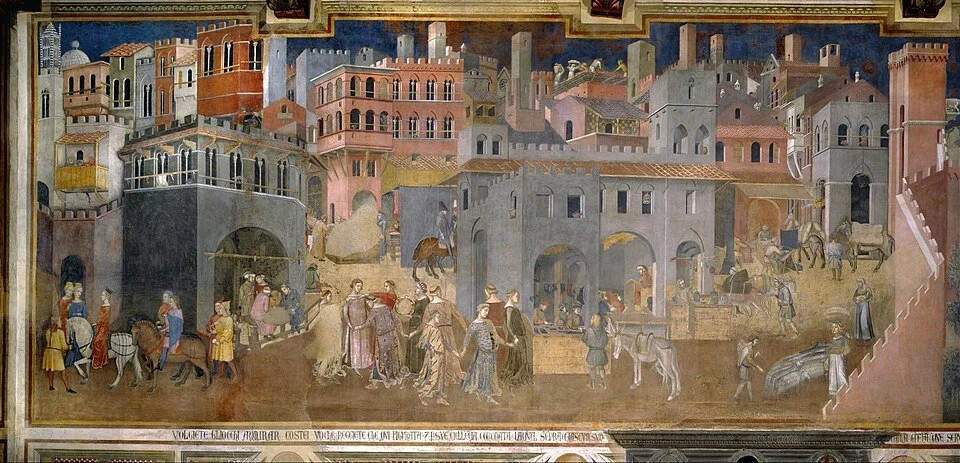
A detail from the Allegory of Good Government - (Wikicommons)
In the Allegory of Good Government there is no God in heaven, no Virgin in blue, no Christ on the cross. The eye has to search, and finds, off-centre, a grey-haired, full-bearded figure representing the Common Good, surrounded by Peace, Fortitude, Prudence, Magnanimity, Temperance and Justice. Below them, twenty-four citizens walk in procession, each with a hand on the same cord, passed down to them by Concord.
I watch a group of American art students follow their teacher into the room. They sit in the familiar, exhausted posture of young people dragged out of bed too early, finding whatever bench they can and leaning against one another. The teacher lectures, while some scroll on their phones and others whisper and giggle. Of perhaps twenty, only two seem to follow her finger as she indicates details. As a former history teacher, I know those two well. I know the other eighteen even better.
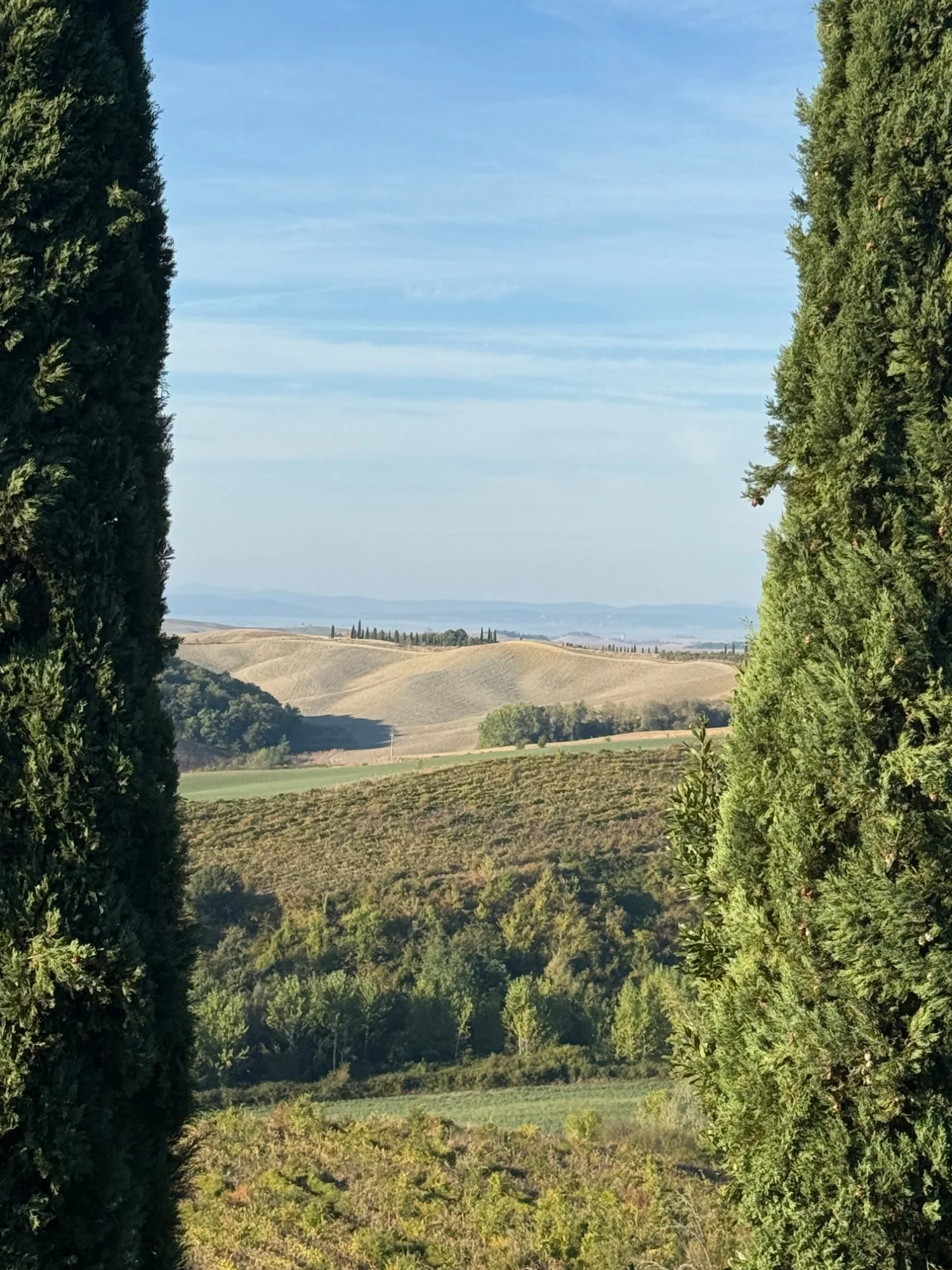
Lorenzetti would need to make few changes to his landscape if he were here today. That afternoon, with the bikes repaired, we ride out of the city through rolling grey-brown hills: ivory-white roads lined with cypresses, wooded gullies, great fields of ploughed earth. No pylons, no traffic, no structures of steel and glass. We share the roads with other cyclists, grinding, like us, up the gravel slopes.
I find it unsettling rather than inspiring. Something seems to be missing from the scene: my own epoch, the signs of the progress that has brought us to where we are now. The present feels like a trespass.
The agriturismo where we are staying deals with us efficiently. Bikes here, bodies there. Keys, passports, tourist tax and meal times are collected, collated and explained. There is a pool, but the air is cooling, so we opt instead for beer and a large bowl of peanuts: essential pre-dinner nourishment.
In our creased and slightly worn evening clothes, we provide a sharp contrast to the crisp white shirts of the men sitting at the other tables with their partners dressed for a fashion shoot. They demand their food loudly from the one rather harassed young woman whose job it is to serve us all.
The sun sets. Bats jig in the warm air. A few crickets sing.