A Tuscan Journey (3)
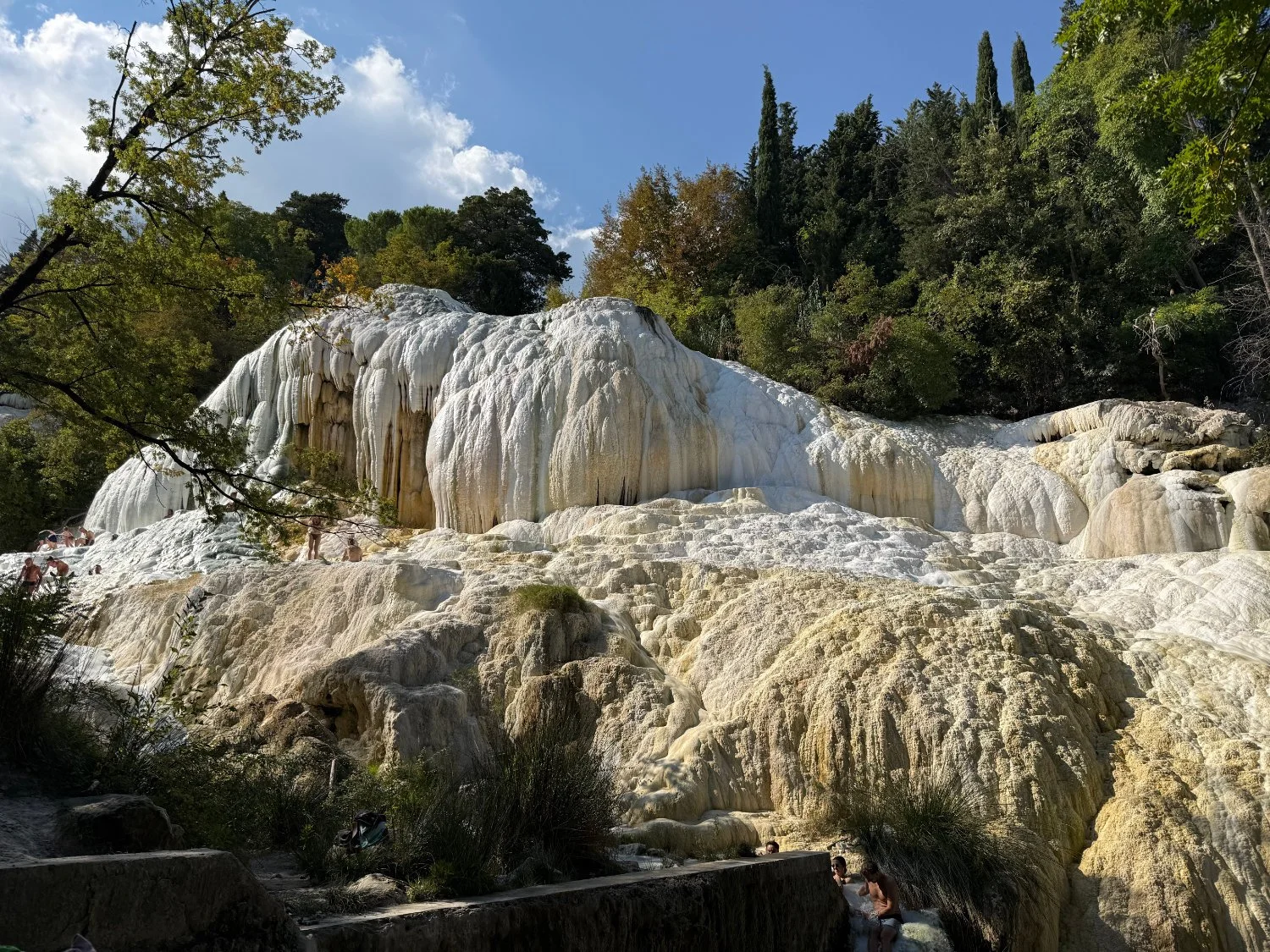
Bagno San Filippo
Yesterday’s ride was through Lorenzetti’s Tuscany, ordered and cultivated. Today we ride across Martini’s: the same empty hills that lie between Guidoriccio and his castle.
Bikes and Lycra rather than a horse in matching livery, but the castles and fortified houses still sit on their hills, the sky is still dark blue, and the fields are the colour of a cappuccino, the earth crusted and cracked.
The day’s first challenge is the longest settore of the Strade Bianche race: Monte Sante Marie. Eleven and a half kilometres of white road, named after Fabian Cancellara, thrice winner of the race. It rises and falls, with short, steep ascents followed by equally steep descents, the gravel loose on the bends.
How fast can one safely go? Each descent I take faster than the last, until the road re-establishes its authority and all but tips me into the verge on a bend.
Reader, I remained upright.
How the professionals stay upright, coming down these slopes in March at speeds I would not attempt on tarmac, on tyres not much wider than my thumb, I have no idea.
Rows of ‘flame-tall cypresses’ lead through the ploughed fields, up to the poderi.
Tuscan cypresses,
What is it?
Folded in like a dark thought
For which the language is lost,
Tuscan cypresses,
Is there a great secret?
Are our words no good?
– DH Lawrence, ‘Cypresses’
Here and there a solitary tree sits on a knoll. In the hazy distance, dark forests form a near-black band along a ridge of hills.
We head towards Asciano over the rolling arabesque of the Crete Senesi, the Sienese clays, pale grey and almost white in places: the bed of a shallow sea, three or four million years ago. We cross the aptly named Deserto di Accona: not a real desert, of course, but the slopes are stripped to the clay. Around us, there’s little that could be described as living.
After a much-needed plate of pasta in Buonconvento, we ride towards the Val d’Orcia, a valley made familiar through the writing of the Anglo-American heiress Iris Origo. When she and her husband Antonio arrived at La Foce in 1924, its farms were poor and neglected, the land ‘lunar, pale and inhuman’. They spent much of their lives restoring it, planting trees and bringing the land back into cultivation. The cypress-lined roads that wind across the valley, the image on a thousand postcards, were planted by the Origos. Iris recalled ‘this vast, lonely, uncompromising landscape’. Today, at the end of September, it has lost none of its loneliness.
We arrive in Pienza late in the day. It is the town a pope built. Enea Silvio Piccolomini was born here in the village then known as Corsignano. As Pope Pius II, he had its centre rebuilt as an ideal Renaissance city and renamed the town after himself: the cathedral, the palaces and the town hall, everything in keeping with everything else and all seen from the one central square.
But this evening the town is hard to see for people. Chinese couples in wedding clothes pose in doorways and on the cathedral steps while photographers direct them. The shops spill their wares out into the street: cheeses, leather goods, linen, bottles of Brunello. It is little different from the scene on the wall of the Palazzo Pubblico, where Lorenzetti shows the city under good government: people buying and selling, a shoemaker with his goods laid out, a teacher with his pupils, young people dancing in the street. Lorenzetti’s citizens come for leather shoes; ours come for ice cream.
From Pienza it is downhill almost all the way to Bagno Vignoni, with one last dusty track to finish the day. The sun is low, shining across the road in long tawny bars. Cypresses turn black against the sky.
***
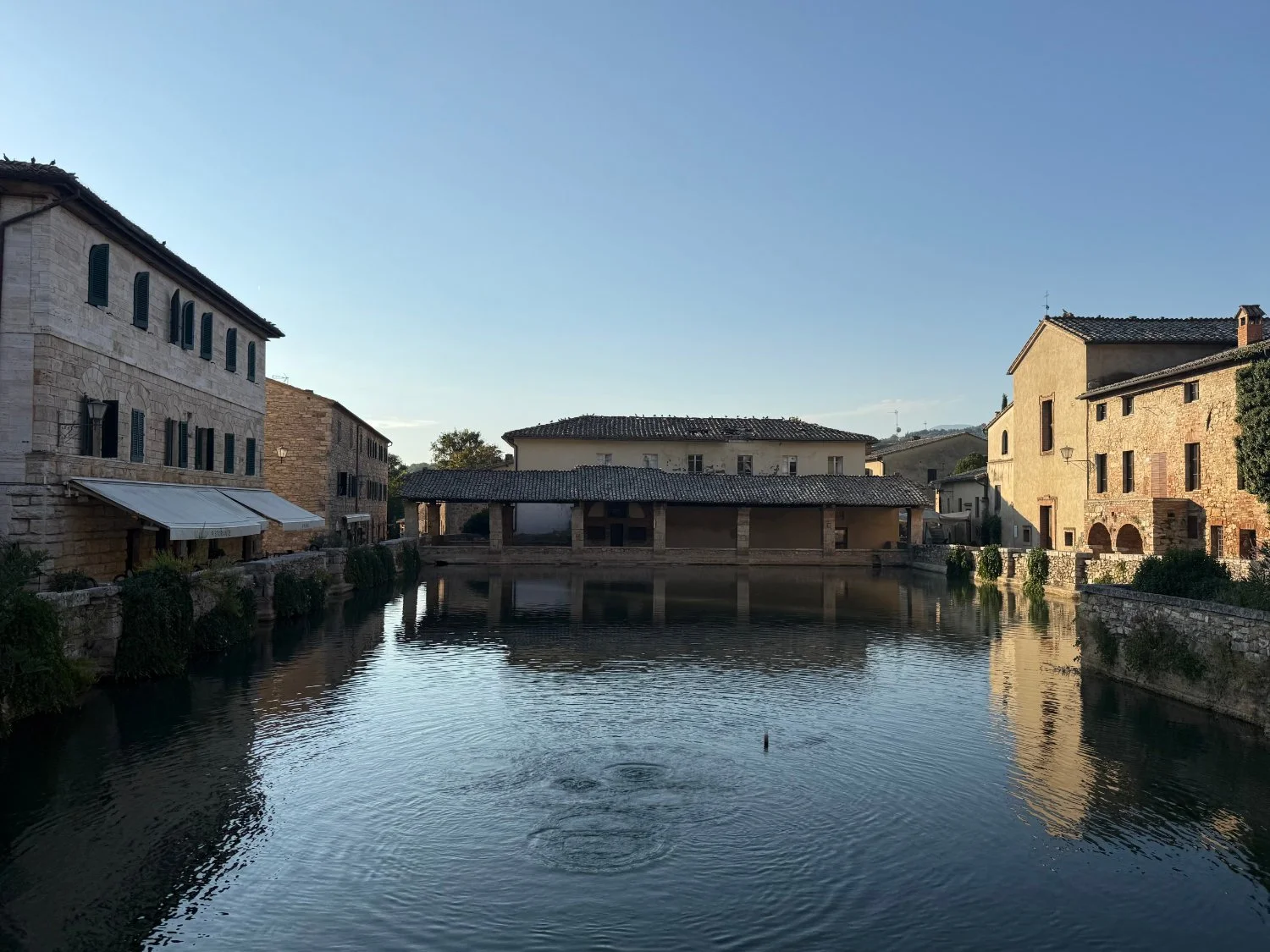
Bagno Vignoni
Bagno Vignoni has no main square. Where the piazza should be there is a steaming pool, in a stone tank enclosed by old buildings, the arches of Saint Catherine’s loggia reflected in the water. It bubbles and occasionally burps its way up from the bowels of the earth. The Romans came here for the waters, and it is easy to imagine the toga brigade parading around the edge in the steam, discussing the day’s business. Saints came too, and pilgrims, and even, they say, Lorenzo the Magnificent. In their day, bathing was permitted; today it is absolutely forbidden. Now it is the peoples of the world, with their cameras.
Our lodging for the night is a locanda, one of the buildings overlooking the pool. It looked good in the pictures when I booked it. Tired, we find the glass door locked, but the owner is inside, sitting at one of the restaurant tables, playing cards with his friends. A sign on the door says chiuso, closed. We knock. He wags his finger at us, side to side, like a windscreen wiper. We knock again. Sighing, he gets up, unlocks the door and tells us he is closed.
I explain that I have booked rooms. More sighs. He goes to his desk, collects four keys, thrusts them into my hands and tells me to sort out the rooms myself. Dinner, he says, is at half past seven.
***
We head out straight onto a climb towards the tower of Rocca d’Orcia, a shaft of stone crowning a sheer rock-face above its neighbouring village, Castiglione d’Orcia. It’s another delectable Tuscan morning: soft early light, cool air crisp enough to bite, autumn turning the leaves yellow and orange. Hills in every direction, including the one we are climbing.
There’s a stretch of white road before we come out onto busier tarmac, a shock after the quiet of the previous days. It is a weekday, and the traffic is working traffic: vans and lorries, builders, farmers. We cut out the chat and ride hard and fast towards the slopes of Monte Amiata. The mountain, a dome-shaped volcano, has long given up exploding, but that does not mean that it’s lost its heat.
Bagni San Filippo, a monumental cascade of white calcareous rock over which blood-warm water pours into pools, provides the first break of the day. From the steep wooded hillside bulges the Balena Bianca, the White Whale, though to my mind it is more like a cathedral organ, all pipes, flutes and crevices of petrified stone: the sort of display usually seen underground in great show caves, not on the hillside of an extinct volcano. John and Andy ride on. Ben and I leave our bikes, change in the woods and spend half an hour luxuriating in the pools. Deep in these woods, I half expect Oberon and Titania to appear; instead, I play Mendelssohn’s A Midsummer Night’s Dream in my head while the water massages stiff shoulders and eases tired limbs.
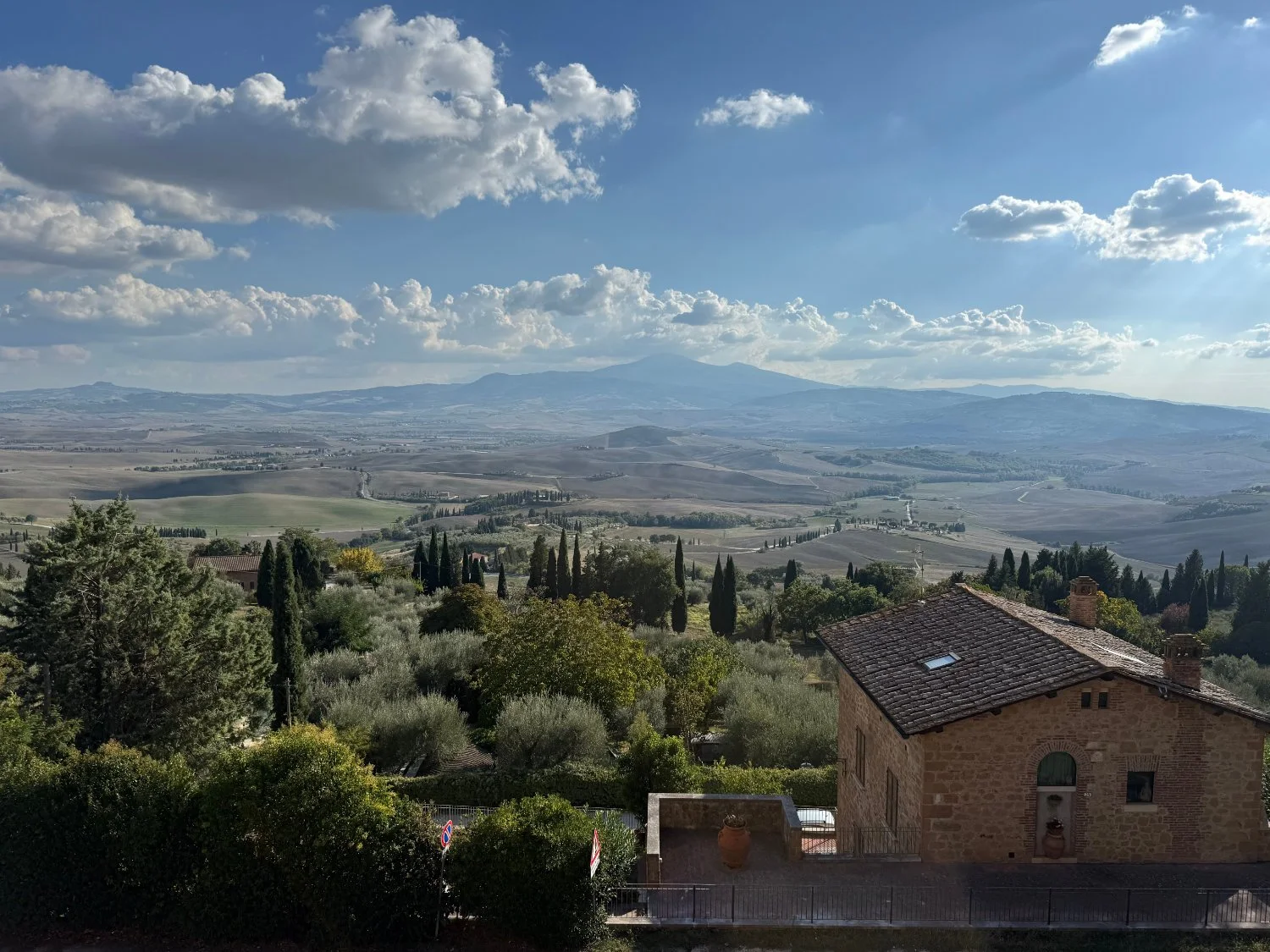
Monte Amiata from Pienza
Reinvigorated, we change back into our Lycra and resume the climb in pursuit of John and Andy. It begins to drizzle. That is not in the plan. My legs are heavy and my throat is sore. Ben drifts past me, which is galling on what I regard as my terrain, the long mountain climb.
I arrive alone, in drizzle, at the old mercury-mining town of Abbadia San Salvatore. It has not made it into the Tuscan Tourist Board’s promotional pictures. A mining town rather than a medieval gem, damaged in the war, it was rebuilt in haste rather than taste. I ride its streets of stark concrete dwellings, but I cannot find Ben or the other two. I try to message them on my phone, but the raindrops add their own words to the predictive text. Frustrated, I head instead for the restaurant I’d listed in the ride notes. There I find that Andy and John have arrived moments before me, and a few seconds later Ben appears. Thank goodness for ride notes.
After lunch we contour around the old volcano before descending to Santa Fiora, a town built of the mountain’s own dark stone. Its vicoli are barely wider than our handlebars, and where we expect a lane we find steps; we wind our way down through the maze more by instinct than by any map. At the bottom of the town, cold, clear spring water wells up into the Peschiera, an old fishpond hidden in a garden, before flowing out as the beginning of the river Fiora. Not all the mountain’s water comes up warm.
Out of the town, a tiny lane, empty but for the vegetation creeping across the tarmac, climbs past the gated entrances of geothermal plants. Huge grey pipes bend, twist and spike upwards, and steam rises out of the deep woods like vapour from a jungle. Over the crest the land softens into vines and olives, and a delicious winding road descends in endless fast corners. Despite the drizzle and the wet surface, we race them: the others for the joy of it, I because I want the day over.
The lads are asking for a tea stop.
‘Come on, Julian, it’s time for tea.’
‘Is there somewhere we can stop?’
‘A gelato would be good.’
I ride on. I would ride past any gelateria in Tuscany today. As it happens, there is none to ride past: the villages have nothing open, no café, nothing. Just dampened ochre houses, tall and stained by rain.
Tea-less, and to the lads’ disgust gelato-less, we end the day at the hot springs of Saturnia. Legend gives them a grander origin than any volcano: Saturn hurled a thunderbolt in anger, and where it struck the ground, the warm water rose.
Below the village, at the Cascate del Mulino, the water spills over a staircase of pale travertine beside an old mill and fills a series of shallow, milky-blue pools. There is a faint smell of sulphur in the air. The springs are free and open all hours, and now at the end of the day there are people sitting in the pools. Andy and I join them. The sun sets, the water is warm, and our shoulders are massaged once more. All is nearly perfect, except that I feel decidedly rough.
By evening I have a cough and a temperature. I think it’s a cold. John suspects Covid. I struggle through dinner at La Stellata while the others, unfazed and in fine form, talk over the day and eat enormous amounts of meat. As tomorrow is our last day, the wine is poured liberally. I leave them to it and head for an uneasy sleep.
***
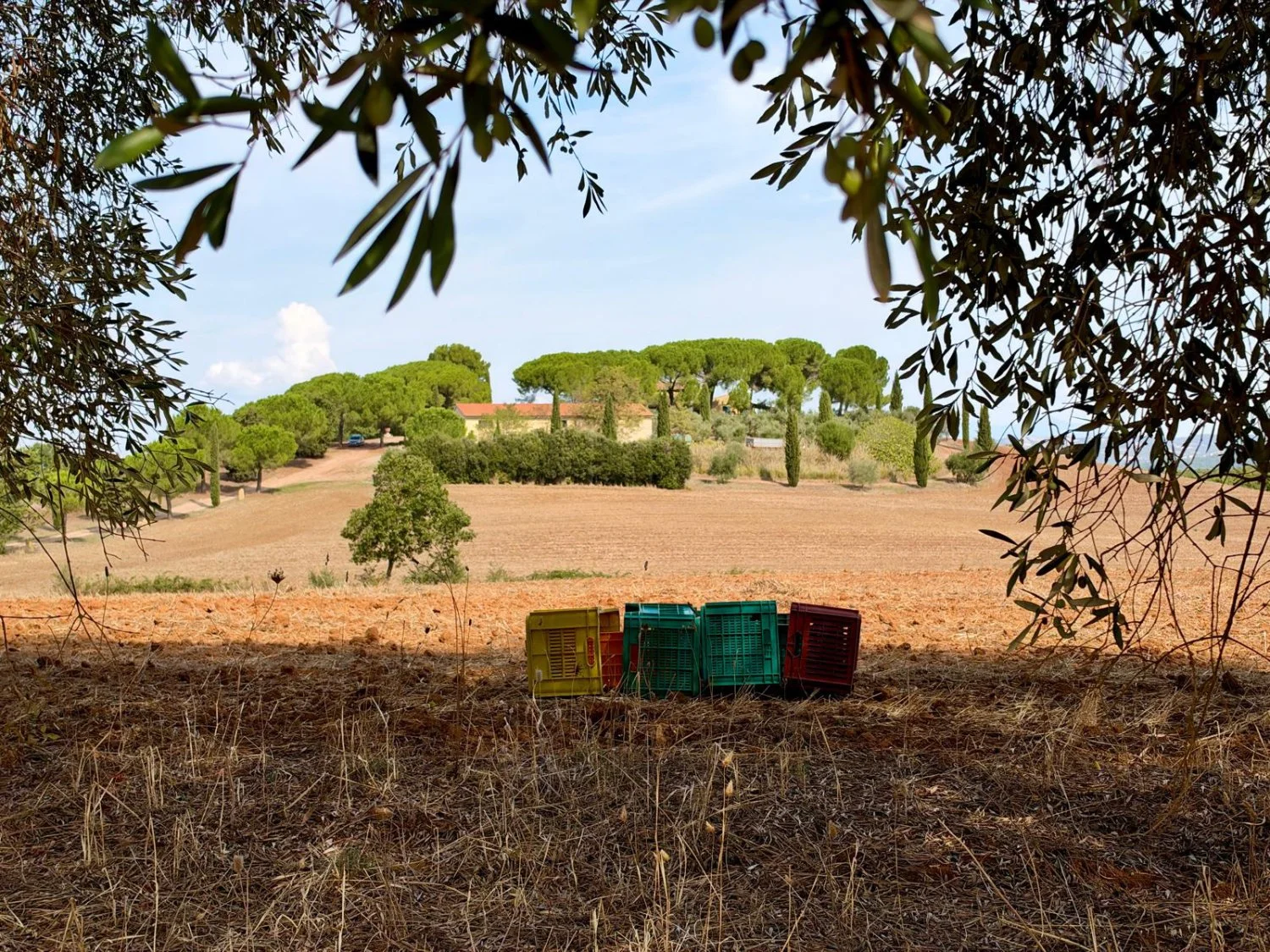
Maremma
I feel no better for the night. The road drops away from the hills, and with every turn of the pedals the country changes. The woods thin out and the land turns dry and red. By mid-morning we are in the Maremma, Tuscany’s wild south-west, and a different, older place. The roads are now rough, stony, broken tracks that make the white roads of the Crete Senesi seem like a bowling green.
DH Lawrence came to this coast in the spring of 1927, looking for traces of a lost civilisation, the Etruscans. Malaria had emptied the land of its people, and time had all but erased their towns. Whenever he asked about them, the answer was the same: ‘Nothing! Nothing! There is nothing there!’ A century later the malaria has gone, but there is still nothing here: no people, no towns, just scrub, a few lines of olive trees, and tracks leading off to I know not where.
Domenico Tiburzi, the last great brigand of the Maremma, il Re della Macchia, the King of the Scrub, roamed these hills and plains, the last great brigand of the Maremma, roamed these hills and plains. My fevered imagination senses that there’s still something slightly sinister hanging in the air. I half expect a rifle barrel to poke out from behind the wall of a ruined farmhouse, followed by a group of rough, unshaven men in battered hats with bandoliers across their chests, demanding my phone. Perhaps my bike.
The others feel none of this. The confidence of a week’s riding has gone to their heads, and they ride fast and roughshod over the stony ground, while I follow carefully behind, keeping an eye on the walls, anticipating an ambush. At last we are back on tarmac, and the road turns towards the coast. Nobody has robbed us. I’m almost disappointed.
We detour to Capalbio. It was near here, in a farmhouse in 1896, that the carabinieri finally caught up with Tiburzi after twenty-four years on the run and shot him dead.
We have come not in search of bandits but for train tickets, for tomorrow’s journey back to Pisa. The station is a small-town halt, deserted, its ticket office shut, its machines not working. There is no one to ask whether bikes must be booked ahead, and the Trenitalia website isn’t helpful. We buy our own tickets on Trainline, but not the bikes’, and hope.
We ride on to the seaside town of Ansedonia along a small lane bordered by umbrella pines and high walls. The place is full of chi-chi gated villas, shut for the season. Above it, on the hill, are the walls of Cosa, a Roman colony. When the poet Rutilius Namatianus sailed past in 417, it was already deserted. He said a plague of mice had driven its people out. Sixteen hundred years later, the villas are shuttered and there’s no one about. Perhaps the mice are back.
In town there is one restaurant. An old man in stained clothes and baggy, once-white trousers shuffles out of its dark, faded grandeur and assures me, in slow, pondering Italian, that he is open.
This turns out to be a matter of opinion.
We clack across the marble floor to a table on the terrace. Paint is peeling from the walls, and chairs are stacked in dark, closed-off rooms. It is as if the last customers left in about 1987.
He brings out one fork, returns for another, and in this way, fork by fork, sets the table. Plates are clattered and crashed onto the tablecloth. From a much-used menu, stained brown by many fingers, we all select the same simple tomato pasta. He writes our order slowly on a small pad, his brow furrowed, as if composing a difficult letter. He grunts and groans, his face black with annoyance.
Once he has shuffled off to the kitchen, we wonder what has happened to him. Perhaps his wife or his lover left him this morning. Perhaps the tax authorities have announced they are coming for him. Perhaps the bandits failed to assassinate his arch-enemy, and he fears he might be dead himself by tonight. We don’t know, but by the time the food arrives we have given him a full and tragic life story, and we are rather fond of him.
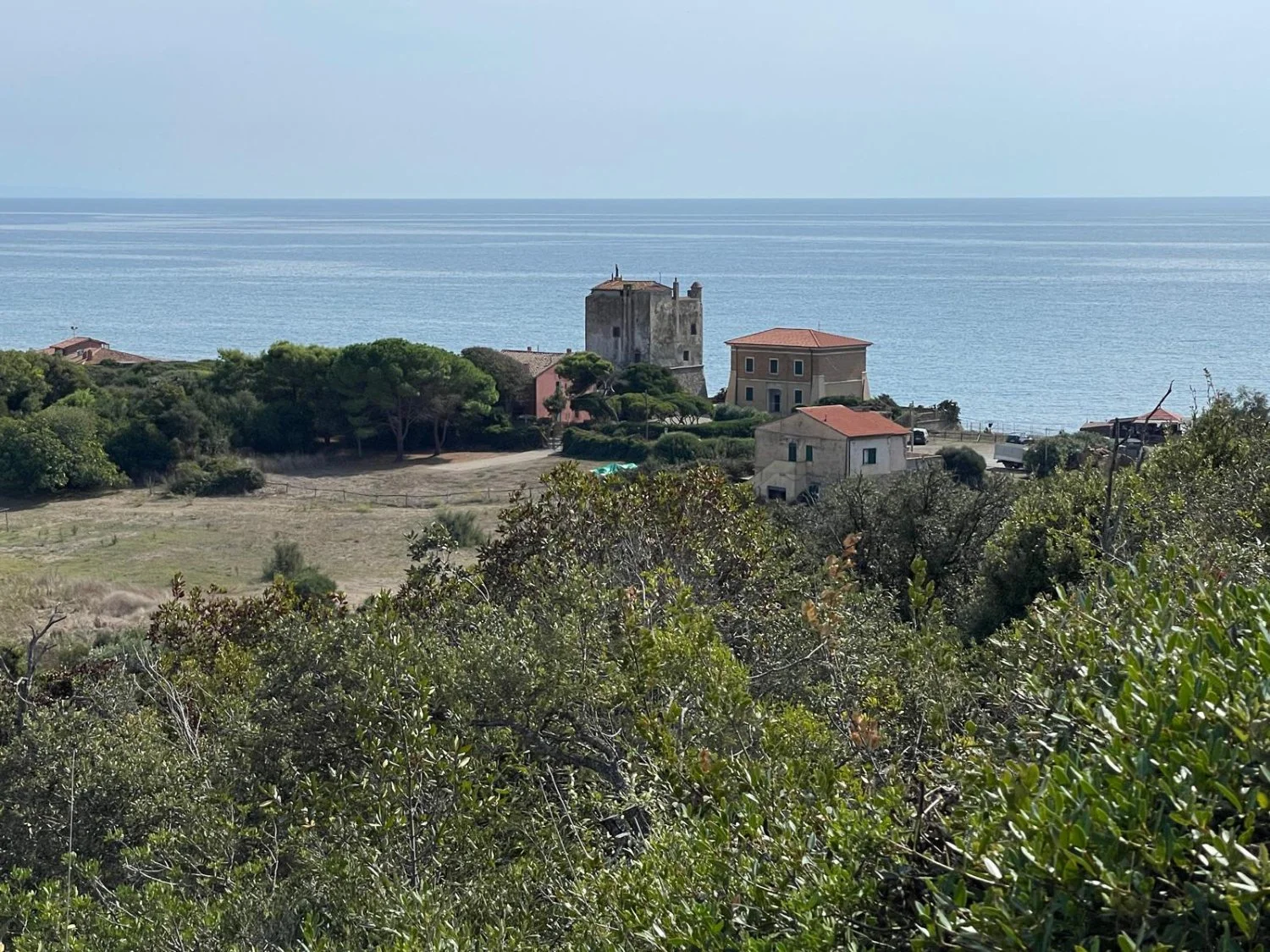
Ansedonia
Beyond the terrace, meanwhile, the Tyrrhenian Sea is blue and glistening, framed by pines. It could almost be the coast at L’Estaque that Cézanne painted in Provence: rocks, bays, red soil, the dark scrub of the macchia.
The pasta, when it comes, has not been made with love, and tastes weak: more red water than tomato. We ask for water. Glasses arrive in ones and twos, and fifteen minutes later a carafe. Payment takes an age while the card machine is found and plugged in. From the stale air of the empty dining room comes a long sigh. We wait for the internet to creep down the line.
Free at last, we head to Orbetello, an ancient port on a narrow tongue of land which spears out into the middle of a lagoon, and then onwards along the causeway that runs across the still and silvered waters to Monte Argentario. In the shallows, pink flamingos stand on one leg.
There are two final short climbs before the trip ends at Porto Ercole. The town is tucked into a bay, its old houses stacked up the hillside above the harbour. Three Spanish forts stand over them: the Rocca, Forte Filippo and, on its own headland, the star-shaped Forte Stella. Expensive yachts lie at their moorings; fishing boats are drawn up along the quay.
We park our bikes for the last time at the Hotel Conchiglia, a small, family-run place a street back from the harbour. The owner moves his son’s bike out of the yard to make room for ours: the warmest welcome of the trip, and a world away from the card players of Bagno Vignoni. At last, gelato. The scoops are enormous, and as much ice cream ends up on our noses as on our lips.
This is where the story that began on the wall of the Palazzo Pubblico comes to an end. In 1328 Siena celebrated its conquests in the Maremma with Guidoriccio riding past Montemassi. In 1555, after Siena itself had fallen to the Medici, some of the last defenders of the Sienese Republic held out here for twenty-four days before surrendering. Vasari painted their defeat for the great hall of the Palazzo Vecchio in Florence.
I have spent a week riding through other people’s centuries. It is a landscape so preserved by its own history that the present feels like a trespass.
My cold, or whatever it is, has settled in properly now: my head is thick, the cough won’t stop, and I’m hot one minute and shivering the next. All day, on the rough tracks of the Maremma, I have been thinking about the people who came this way when they were ill: Lawrence, already suffering from the tuberculosis that would kill him three years later, coughing his way from one Etruscan tomb to the next; Caravaggio too, who came here in the summer of 1610, already sick, and died of a fever before he could reach Rome. His bones are believed to lie in the town’s cemetery. Perhaps, I think, I might end up beside the great artist, but the paperwork for repatriating my bike would be a nightmare for my wife. Perhaps it would be easier to be buried with it.
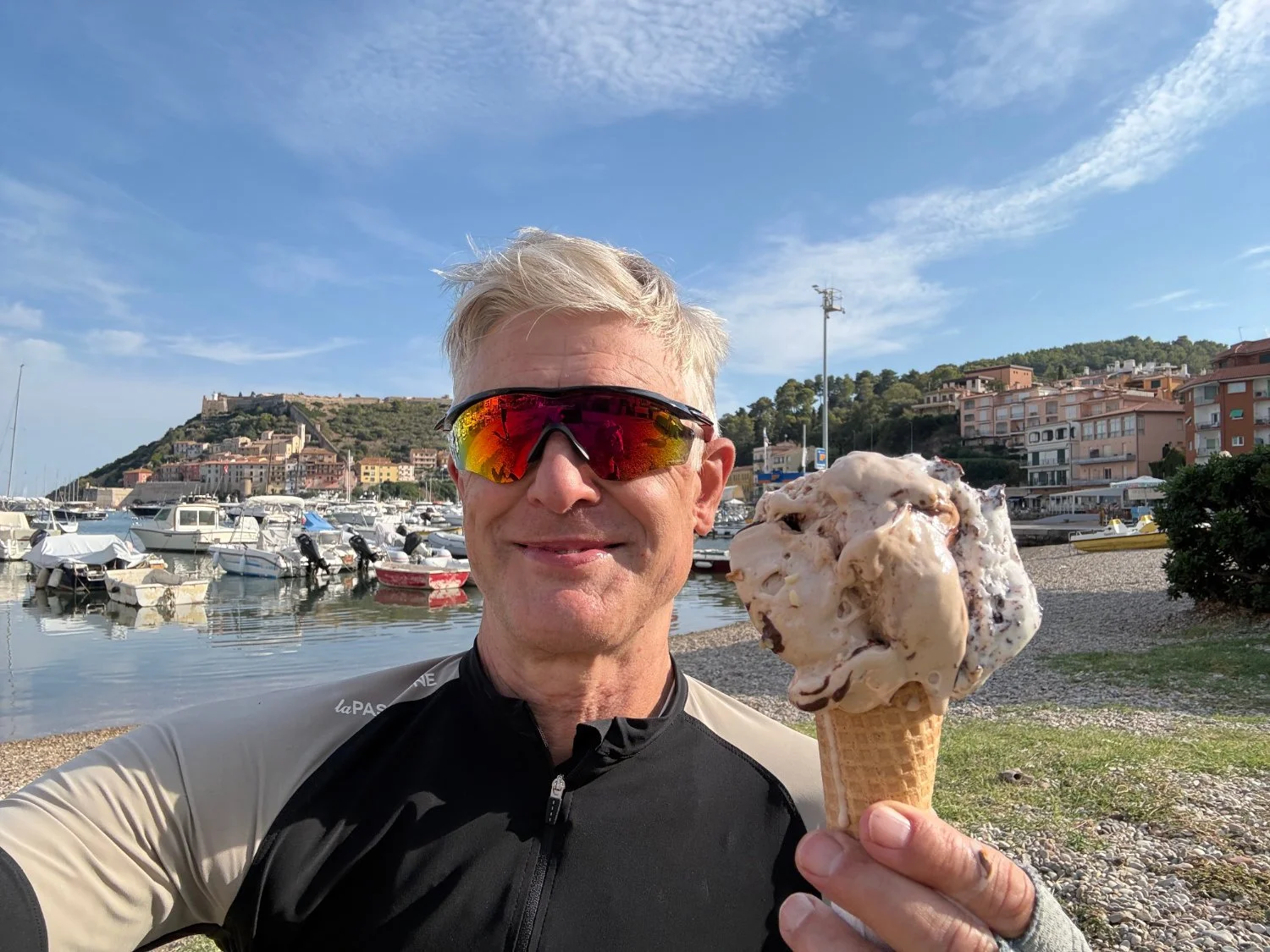
Julian Kirwan-Taylor at Porto Ecole
Later, at the Gamberorosso, we sit at a table by the water as the lights come on around the bay. Course after course, all of it from the sea in front of us, ending with a whole fish grilled and filleted at the table. And there is plenty of wine from the Maremma.
We raise our glasses to the white roads, to the hills, to the hot springs, and to our host at Ansedonia, wherever he is tonight.
Nobody brings the forks one at a time.
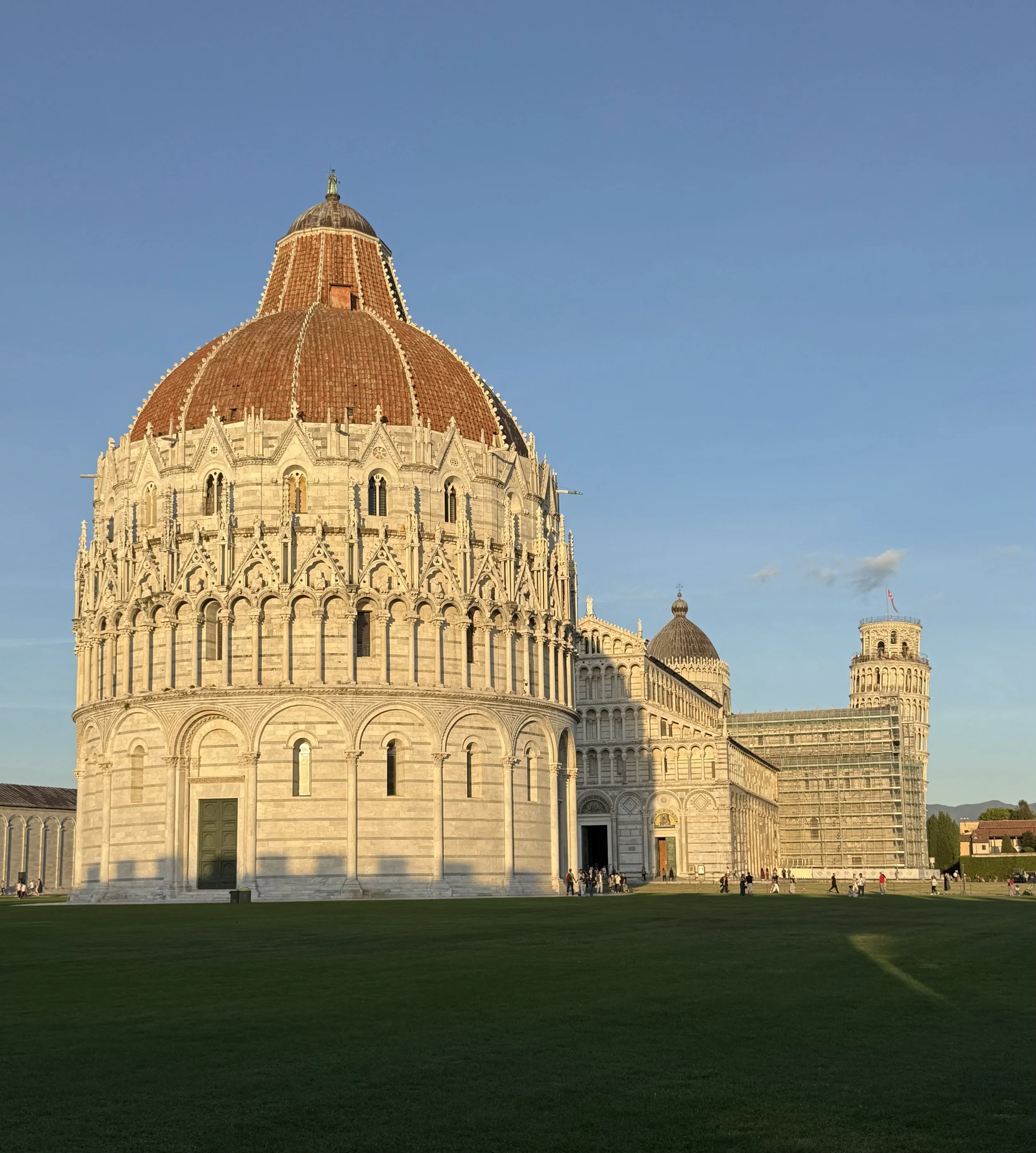
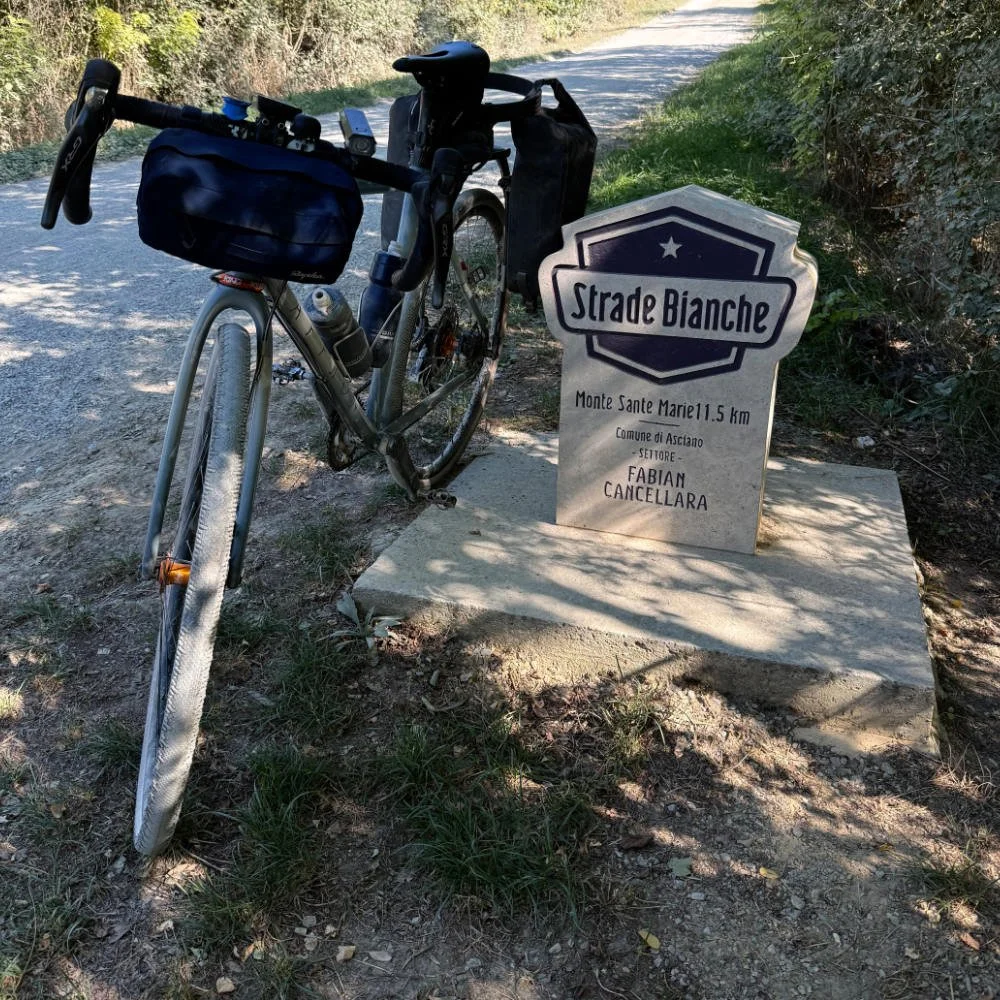
The Gravel roads from Pisa to Porto Ercole