400km across the East Midlands
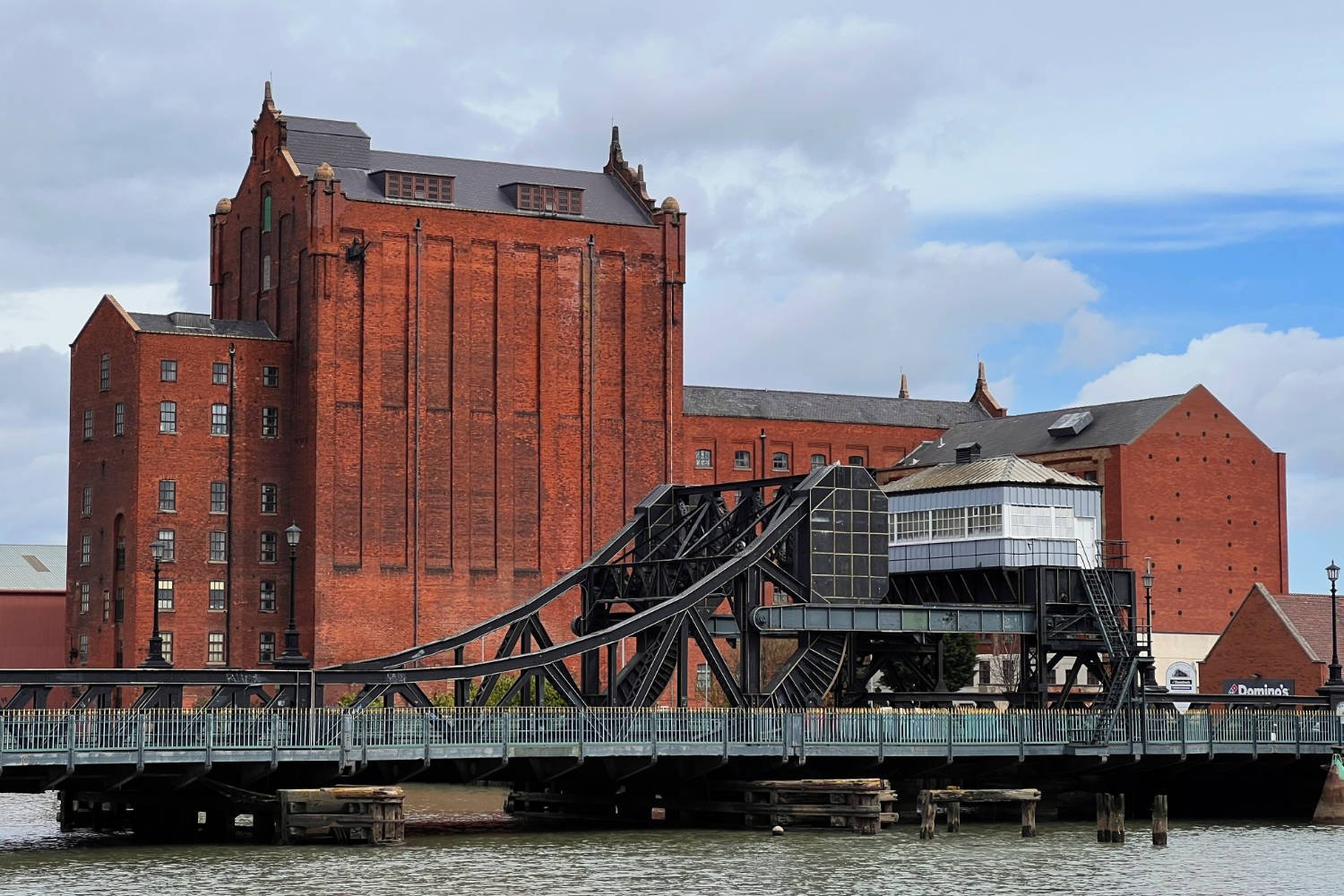
Grimsby’s Docks
Sometimes, places surprise us in unexpected ways.
Greeted by the chaotic laughing of gulls perched on rooftops, I rode to the journey's end at the foot of the Torre di Mangia, an exact replica of Siena's famous tower. The air smelt of sea and trawlers and the fresh, sea-flesh of cod and haddock. Around the old port, the austere deep-red brick of the Victorian warehouses, mills and stores stood against the lavender spring light, monuments to a great industrious past.
Grimsby marks the end of the Fish Road, a 400km cycle route from Billingsgate, London's historic fish market. It's a gentle journey, full of understated but magnificent places, free of traffic and crowds, across the gentle hills and Fens of the East Midlands.
There are treasures and surprises all along this route. I feel my way into Peterborough Cathedral, running my hand over the grainy Jurassic stone and protruding fossils. Inside, a Titanosaur — among the largest creatures ever to walk the earth — greets you in the nave, its massive head bowed. For medievalists, the cathedral is the country's most original piece of medieval architecture, its vast triple-arched west front unlike anything else in England.
I stop at Tattershall Castle, made from a million hand-made bricks on the orders of Ralph Cromwell, Henry VI's Lord Chancellor, who in the 15th century helped himself to vast sums from the nation's treasury. In the warm spring sunshine, the mix of hot dry mineral dust, baked clay and the subtle sweetness of old mortar adds a touch of unexpected exoticism to the visit.
Planes played a big part in the trip. I rode, after all, through Bomber Country, where 48 airfields were used during the war. But it was the modern aircraft — the Typhoons, which scramble regularly to intercept Russian incursions — that provided the most visceral and thrilling sight, and sound. Watching them launch from RAF Coningsby with their cones of fire, their shattering noise, their near-vertical climb before vanishing into blue sky within seconds — that was my own magic moment of the trip. To add to the aviation theme, the hotel in Hatfield was an art-deco wonder, designed around the footprint of the de Havilland DH.88 Comet — the plane that broke the London-to-Australia air race record in 1934, completing the journey in 70 hours, 54 minutes and 18 seconds.
If Typhoons gave me my most thrilling moment, the most sobering was the fate of Grimsby’s young boys. Take Albert Pye — age unknown, but likely around 12 when he was taken from a workhouse as an apprentice on the fishing smack Climax. Beaten, starved and abused, he is recorded as "lost overboard" on 9 August 1880. Or George Taylor, another young boy bound to a Grimsby fisherman named John Hill. In September 1860, after trying to escape his terrifying conditions, he was captured and sentenced to 14 days of hard labour in the House of Correction. There are hundreds of such cases. Workhouse guardians happily paid fees to smack owners to take orphans and destitute boys off their hands. Many died, their names unrecorded, their bodies tossed overboard, the boat crew unpunished. Their lives, and the unbelievably harsh conditions of all fishermen, are documented brilliantly in Grimsby’s Fisheries Heritage Centre. (It is said that deep sea fishing is Britain’s most dangerous peacetime occupation.)
Buying fresh fish straight from the sea at one of the town’s many fishmongers — vacuum-wrapped to take home — was another reward for having come this far. And before taking the train home, there was a final treat; lunch at Samphire, a restaurant attached to a college where young chefs are trained. Cheap and delicious — three courses skilfully prepared for £12.95.
And what of the ride as a whole and the countryside that the you travel through? It is a route across a gentle England — waves of chalk downland, grass-covered and crop-covered. Then, the Fens flat and mysterious, where the sky becomes the landscape. Field-edge bridleways, tracks and quiet country lanes, carry you across the East Midlands from fish market to fish market.
Yes, 400 kilometres is a long way to ride for vacuum-packed fish and a lunch cooked by teenagers. The route is perhaps more about the journey than the destination. It rewards the curious. The Fish Road, you'll find, is far more than the sum of its scales.
If you enjoyed this guide, why not subscribe to the website so as not to miss other inspirational routes? Feel free to comment on the piece below.
wheremywheelsgo.uk is a Feedspot UK Cycling top website